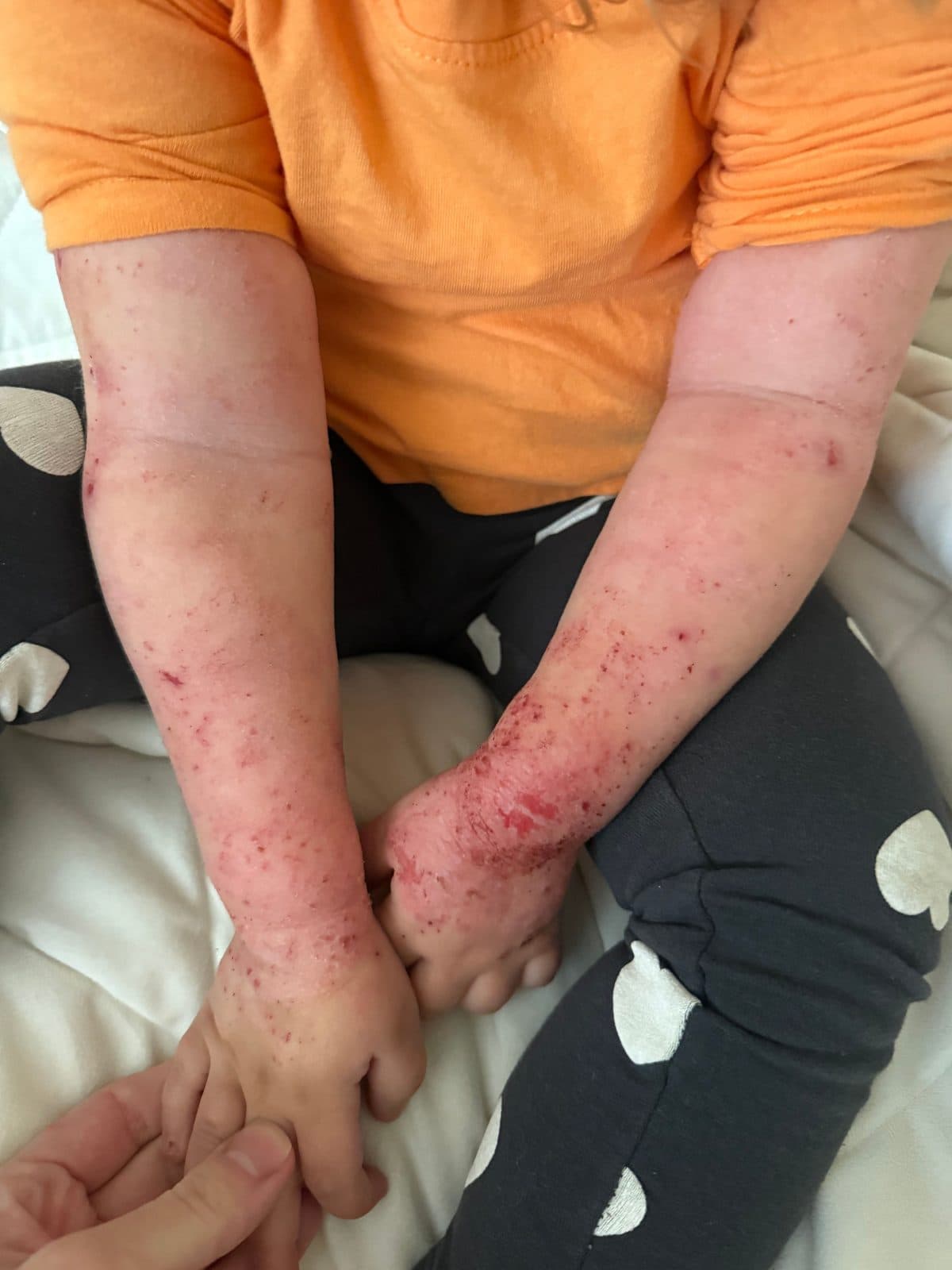
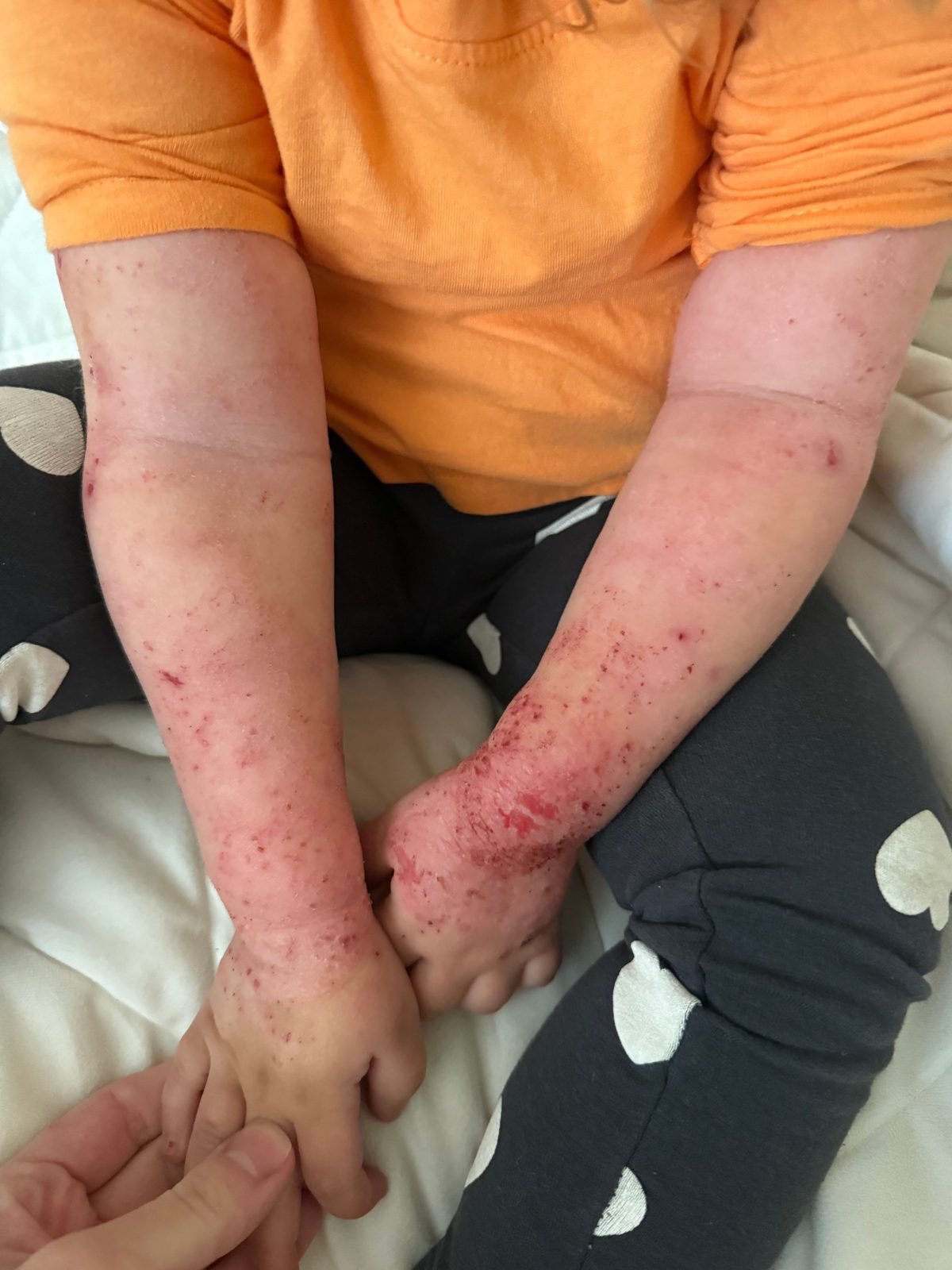
2-3-year-old, on full solid foods, Calabasas-based, presenting after 1-2 years of chronic eczema with bilateral lichenification at the wrists, scratching to bleeding, and a documented OTC steroid rebound. Pattern: Blood Dryness Generating Wind, rooted in Spleen Qi Deficiency. 99 days into a phased dietary, topical, and herbal protocol that included one mid-protocol acute iatrogenic flare from a children's melatonin product. Wounds have cleared, the worst lichenified wrist patch is visibly softening, and the case is the cohort's bridge from infant to toddler treatment.
At a Glance
When Kira's mom reached me on January 30, 2026, Kira was somewhere between two and three years old — by far the oldest baby in the cohort — with chronic eczema that had been building for one to two years. Bilateral forearms and wrists were involved, with an unmistakable patch of leathery, thickened skin at her left wrist that her mom described as "always the worst spot." She was scratching to blood. She was waking at night, demanding her mom scratch her arms and back. The family had spent $500-1,000 trying to fix it from the outside — Aquaphor, CeraVe, hydrocortisone, allergy testing, an allergist, probiotics, a Tiny Health gut test that had flagged depleted beneficial bacteria, and a course of antibiotics before a summer 2025 trip to Japan that everyone now suspected had pushed the eczema deeper.
The pattern was clear and notably different from Poppy's case: where Poppy was floridly Damp-Heat with weeping crusts, Kira's surface had already burned through the wet phase. The lichenification, the dull pinkish-red (not bright cherry-red) erythema, the chronic 1-2 year duration, the steroid rebound, and the pale, slightly puffy tongue with a thin white center coating all converged on Blood Dryness Generating Wind, rooted in Spleen Qi Deficiency (脾虚血燥生风,兼夹湿热蕴肤). Initial AI-assisted pattern confidence: 0.85.
By Day 7, after pulling cow's dairy and switching off heating topicals, the wounds were healing and her mom could see legs that were "almost normal." By Day 21, the worst lichenified left wrist was visibly softening. We hit one significant detour — a flavored children's melatonin introduced for sleep triggered an acute spreading rash that cleared in days once removed. As of Day 99, Kira is in a transitional phase: wounds cleared, deep patches reorganizing, smaller flares surfacing in new locations as the body works through layers it has been carrying for years.
She has not used a steroid since the protocol began.
Presenting Picture
Kira's eczema started somewhere between 6 and 12 months — right at the introduction of solid foods. By the time her mom reached me at age 2-3, the picture had been entrenched for over a year:
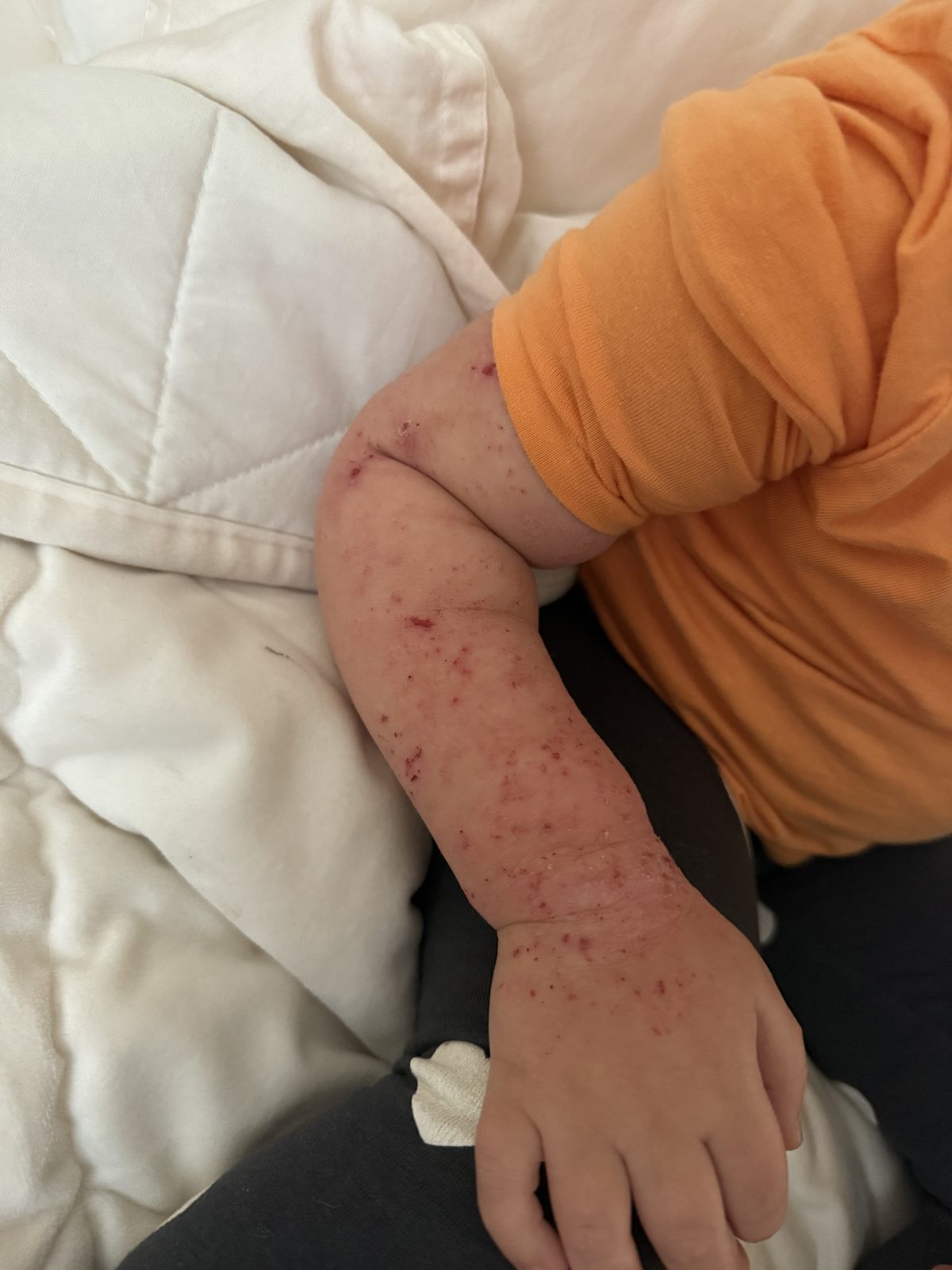
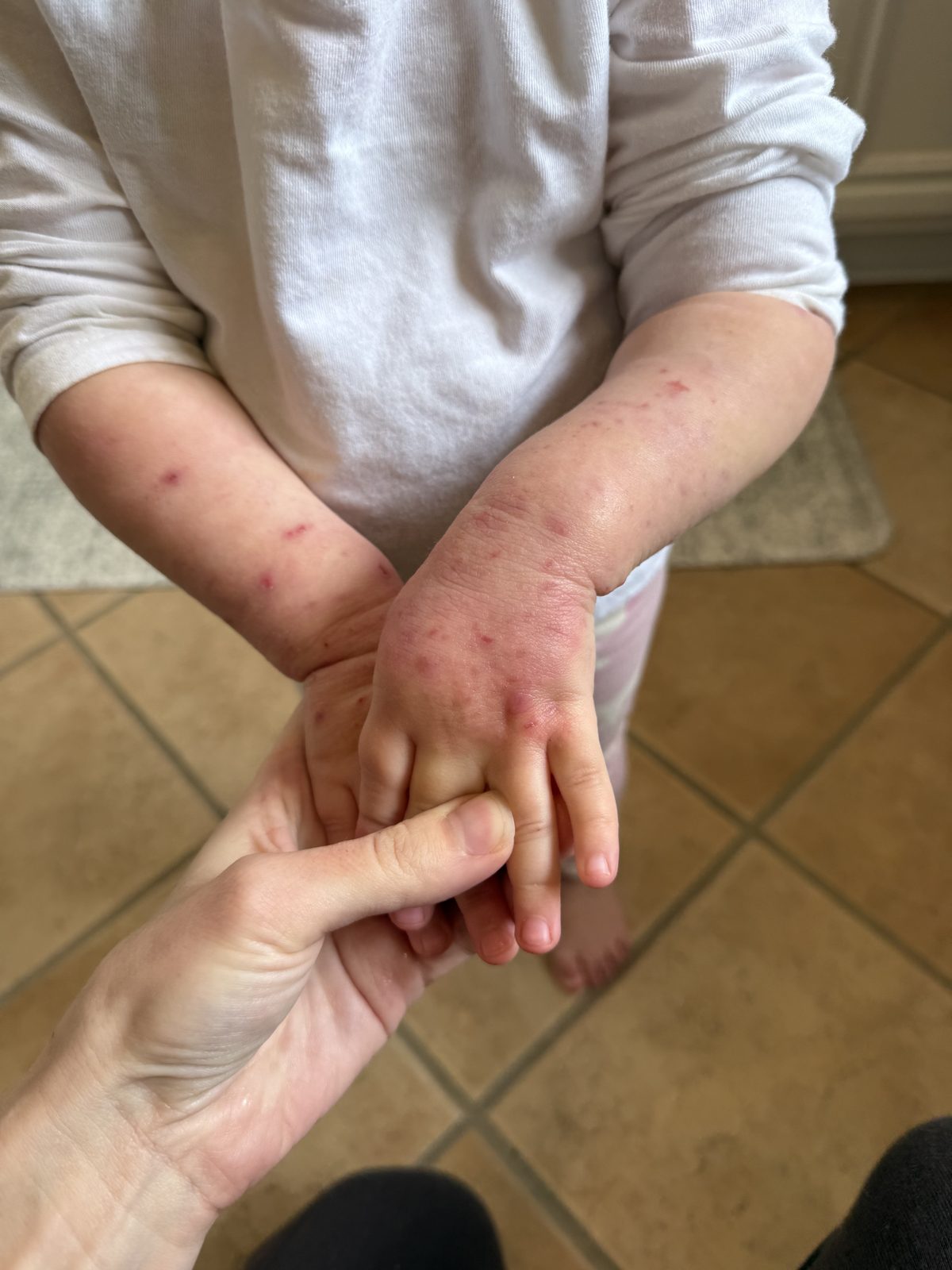
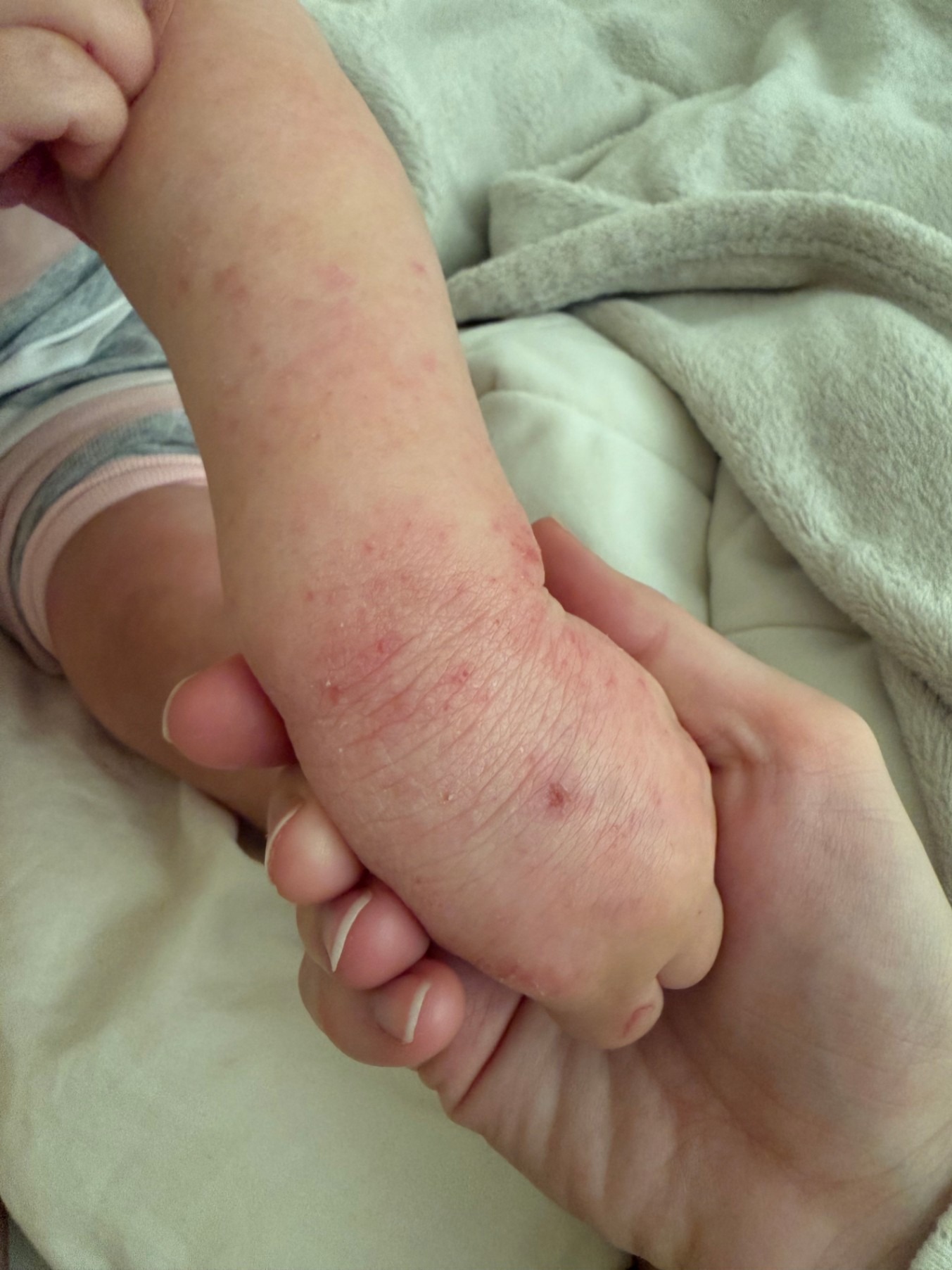
- Skin: Diffuse dull pinkish-red erythema across both forearms. Bilateral lichenification at both wrists, left wrist most severe — thick, leathery, the textbook signature of Blood failing to nourish skin over many months. 30-40+ punctate hemorrhagic crusts and several linear excoriations across the forearms. Fresh blood at the wrist. Scattered torso involvement; described as "all over." No active oozing — surface already past the wet phase. (See
intake-eczema.jpg,w-1-2026-01-29-02.jpg,w-1-2026-01-29-03.jpg.) - Itch: Severe. Constant. Scratching to blood. Waking at night to scratch and demanding to be scratched.
- Sleep: Disrupted for both Kira and her mom.
- Digestion: Normal stools, well-formed. No bloating. No reflux. Surface-normal digestion with severe skin disease — the diagnostically interesting finding.
- Mood: Generally good, increasingly moody and irritable, tantrums, scratching more when upset.
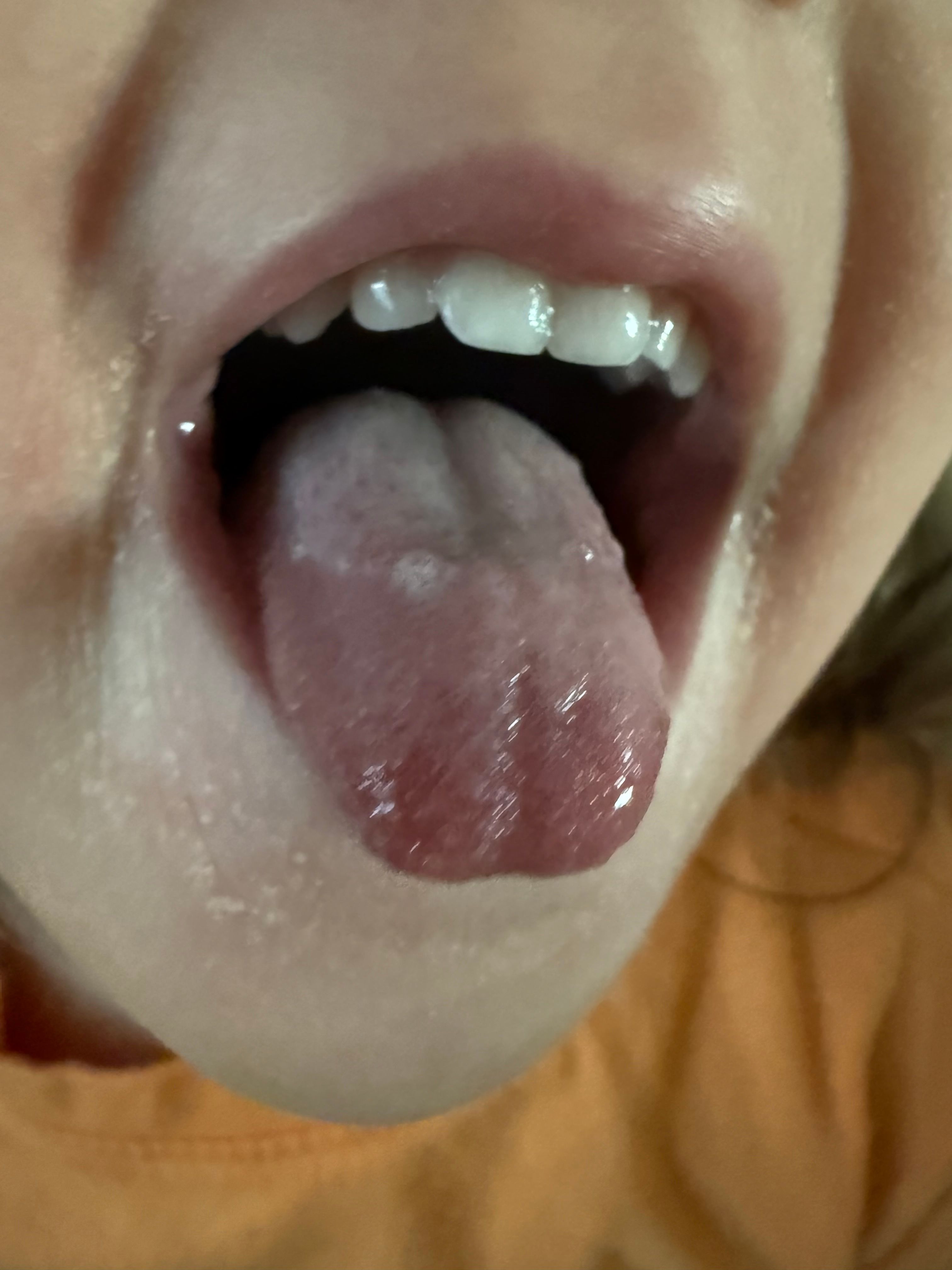
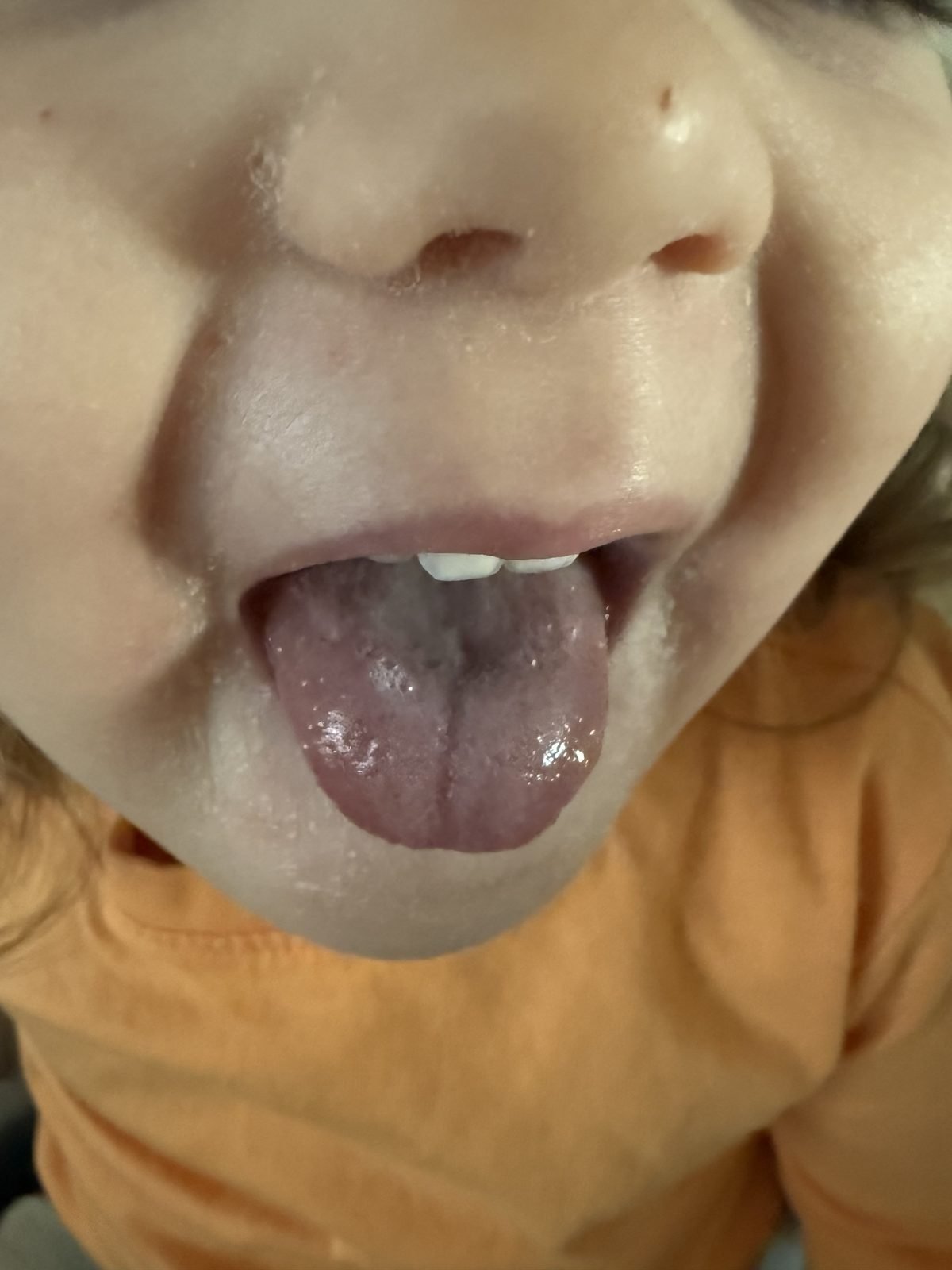
- Tongue: Pale pink, slightly puffy, thin white-grayish coating thickening at the center. Adequate moisture. No yellow coating. No red tip. (See
intake-tongue.jpg.) - Constitutional notes (V2 intake): Prefers cold drinks. Was drinking cold raw cow's milk daily. Rarely sweats. Goes blotchy when crying.
- Heat aggravation: "No clear pattern." Better in Hawaii fall 2024 (warm, humid, ocean); worse in Japan summer 2025 — but a course of antibiotics ~1 month before that trip almost certainly mattered more than the climate.
The lichenification is the pattern signature. Skin only becomes that thick when the body has been failing to nourish it for many months — long, slow starvation of the surface tissue from within.
What They'd Tried
Before reaching out:
- Moisturizers (Aquaphor, CeraVe)
- OTC hydrocortisone (worked temporarily, then came back worse)
- Probiotics
- Allergy testing + allergist consult (results never fully shared with us)
- A Tiny Health gut microbiome test showing depleted beneficial bacteria
- A course of antibiotics for an ear infection ~1 month before a summer 2025 Japan trip — the family suspected this was where things had inflected for the worse
- A previous TCM practitioner who recommended Xiao Feng San — Kira's mom stopped it because she felt it wasn't doing anything (which was diagnostically informative — see below)
- Beef tallow as a moisturizer
- A handmade plantain / calendula / camphor cream from a friend
- A topical hydrochloric-acid-based wound product
- Approximately $500-1,000 spent
Three things stood out from this list. First, the steroid rebound was the same dynamic we see across the cohort — temporary suppression, deeper return. Second, the Xiao Feng San not working was a diagnostic signal: that formula is built for acute Damp-Heat with weeping, oozing skin. Kira's pattern had already evolved past that phase into Blood Dryness, so it had no traction. Third, the antibiotic course was the most likely inflection point in the recent history — the Tiny Health test confirmed downstream microbial damage, and the gut-skin axis is central to her pattern.
Three independent diagnostic streams — tongue, intake history, and presenting skin — converged on a single pattern. A fourth — the family's own Tiny Health gut testing — added a microbial layer that reinforced the Spleen diagnosis.
Tongue findings
- Body color: Pale pink, tending pale → underlying Qi and Blood insufficiency
- Body shape: Slightly full, mildly puffy, possibly mildly scalloped → fluid retention from Spleen Qi Deficiency
- Coating: Thin white-grayish, slightly thickened in the center → residual Dampness in the Middle Jiao
- Coating color: White, not yellow → Heat is not primarily in the digestive organs
- Surface: Adequately moist → Yin not yet severely depleted; Dampness has been pushed outward to the skin rather than fully drying out internally
- No red tip, no cracks → Heart Fire and severe Yin depletion both ruled out
The tongue tells a different story than the skin. The skin says "dry, depleted, starving." The tongue says "Dampness is still in here — it just isn't getting transformed, and it isn't reaching the surface as nourishment." That contradiction is the diagnostic key.
Skin findings
- Lichenification at wrists → Blood Dryness from prolonged failure of Blood to nourish
- Dull pinkish-red, not bright red → chronic Heat that has consumed Yin; past the acute phase
- Bilateral symmetry → systemic internal pattern, not contact irritant
- Wrist/hand predominance → Lung and Large Intestine meridian pathways → Lung-Spleen axis
- 30-40+ excoriations with bleeding → severe Wind from Blood Dryness
- No active weeping → Dampness has largely transformed at the surface
Intake red flags
- Onset at 6-12 months coinciding with solid food introduction → Spleen overwhelmed by digestive transition (脾常不足)
- Normal current digestion despite severe skin disease → "skin-dominant Spleen deficiency": the Spleen handles gross digestion adequately but fails at the deeper job of generating Blood
- Steroid rebound → suppressed pathogen driven deeper; Blood/Yin consumption accelerated
- Antibiotics + Tiny Health-confirmed microbial depletion → Wei Qi damage at the gut-immune interface
- Prefers cold drinks, drinks cold raw milk → contradicting what a weak Spleen needs; actively reinforcing the pattern
- Scratches more when emotionally upset → Liver involvement (Liver Heat / stagnation generating Wind)
- Eczema better in Hawaii (warm, humid) and worse in Japan (after antibiotics) → external climate matters less than the internal microbial picture
Triangulation
The Spleen tongue signs (pale, puffy, white center coating) confirmed the root (Spleen Qi Deficiency producing internal Dampness while failing to generate Blood). The lichenification confirmed the chronic Blood Dryness at the manifest level. The dull-red erythema confirmed residual Damp-Heat lingering at the skin without primary Heat in the digestive organs. The bleeding from constant scratching confirmed Wind generated by Blood Dryness (血燥生风). The increased scratching during emotional upset confirmed a Liver Heat layer adding to the Wind. The antibiotic history and gut test confirmed Wei Qi damage at the level of the gut microbiome.
Why the previous practitioner's formula failed
Kira's family had already been given Xiao Feng San by another practitioner; her mom had stopped it because she didn't notice an impact. Xiao Feng San is a beautiful formula — for acute Wind-Damp-Heat with weeping, oozing lesions. Kira's surface is not wet. It's leathery and dry. Adding Damp-draining herbs to that picture would do nothing useful and would further deplete Blood. The formula didn't fail because it was a bad formula — it was the right formula for the wrong stage of the disease. Her mom's instinct that it wasn't helping was clinically correct, and a meaningful diagnostic data point in its own right.
Primary pattern
Blood Dryness Generating Wind (with residual Damp-Heat at the skin level), rooted in Spleen Qi Deficiency failing to generate and nourish Blood Pi Xu Xue Zao Sheng Feng, Jian Jia Shi Re Yun Fu — 脾虚血燥生风,兼夹湿热蕴肤 Confidence: 0.85
Secondary patterns
- Residual Damp-Heat at the Skin Level (湿热蕴肤) — lingering, not primary; explains the persistent dull red color and steroid rebound
- Blood Deficiency (血虚) — pale tongue, severity of itch; the underlying deficiency that perpetuates Blood Dryness
- Liver Heat / Liver Qi Stagnation contributing to Wind (肝热生风) — scratches more when upset, irritable mood, tantrums
- Wei Qi Damage from Antibiotics + Steroid Suppression (卫气受损) — gut microbial depletion confirmed by external testing
Treatment Strategy
Plain English (for parents)
Kira's body has been working with a small, overwhelmed kitchen for two years. The kitchen — her digestion — has been producing just enough basic energy to keep her growing and healthy on the surface, but not enough of the deep nourishment her skin needs to stay soft. So her skin has slowly starved, dried out, thickened, and become unbearably itchy. We are going to do four things at once: clear the few problem foods that are blocking the kitchen (dairy first, wheat and sugar close behind), rebuild the kitchen with Spleen-strengthening foods and herbs, feed the starving skin from inside with Blood-nourishing herbs and tea, and protect and soothe the surface with the right topicals while the inside catches up. The skin will be the last thing to fully turn around — internal healing comes first.
Treatment principle (zhì zé) for clinicians
健脾益气 · 养血润燥 · 祛风止痒 · 兼清余湿
Strengthen the Spleen and tonify Qi · Nourish Blood and moisten dryness · Disperse Wind and stop itching · Concurrently clear residual Dampness
Three constraints shaped how this principle was operationalized:
- Kira is old enough for direct internal herbs. Unlike Poppy (3-6 months, breastfeeding) where every herb had to reach the baby through the mother's milk, Kira at 2-3 years could take pediatric-dosed granules directly. This opens the herbal toolbox significantly and is part of why this case is the cohort's bridge from infant to toddler treatment.
- The dietary lever is more complex. Kira eats a varied solid-food diet. Modifying her input means addressing dozens of foods, several preferences (cold drinks, raw cow's milk), and a toddler's developmental refusal capacity. This is harder than the Poppy case where a single mother's diet controlled everything.
- The mother is exhausted. Her mom had been sleep-deprived for weeks before we met. Caregiver burnout is a real clinical variable — a protocol the parent cannot sustain is a protocol that fails. Several decisions through the 99 days have been calibrated to caregiver capacity, not just clinical optimum.
Day 4 (Feb 2) — the long sync call
The most consequential single conversation in the case happened on Day 4. Kira's mom sent a long voice memo with a constellation of questions: about milk alternatives, about beef tallow vs. lanolin vs. shea butter, about a plantain-camphor cream a friend had made, about whether she had to give up dairy if she was still breastfeeding occasionally, about whether digestive enzymes could "cancel out" dairy in her own milk, about whether we should add Chinese herbs.
We worked through it point by point. The decisions that landed:
| Question | Decision | Why |
|---|---|---|
| Beef tallow as moisturizer? | Stop. | Warming in TCM nature; enters Spleen/Stomach. Adds Heat to a Heat-pattern child. Would suit a Cold-Damp eczema, not Kira's. |
| Plantain/calendula/camphor cream? | Stop. | Camphor is hot and dispersing. Wrong direction for a Blood Dryness pattern. |
| Aquaphor as primary? | Stop. | Pure occlusive — traps Heat at the skin level during the active inflammatory phase. |
| Almond milk for convenience? | Yes. | Neutral, mildly Lung-moistening. Fine as a transitional substitute. |
| Homemade rice milk with jujube + goji? | Yes — make this 1-2× weekly as therapeutic. | Active medicine, not just substitute. Nourishes Blood, supports Spleen, naturally sweet. |
| HMO probiotics (the family worried they were "dairy")? | Continue — they are not dairy. | Human milk oligosaccharides are prebiotic sugars, not milk proteins. Therapeutic given Tiny Health findings. |
| Eat dairy and rely on enzymes to "cancel" it in breastmilk? | No — enzymes don't work that way. | Lactase breaks down lactose, not casein/whey. The only dairy-free breastmilk comes from a dairy-free mother. |
| Stop bedtime breastfeeding? | No — keep it. | Kira is 2-3 years old; this is a calming ritual for a tantrum-prone toddler. Tantrum-driven scratching is part of the Liver Heat picture. The few ounces of breastmilk are negligible exposure compared to the raw cow's milk we just removed. |
| Add Chinese herbs now? | Yes — Dang Gui Yin Zi + Si Jun Zi Tang, pediatric dose, sequential introduction. | Severity and chronicity warrant escalation. See herbal section below. |
The herbal differential (Feb 2)
Three classical formulas were on the table for Kira's pattern. The differential is worth showing because it is the central clinical decision of the case.
| Formula | Pinyin | Strengths for Kira | Weaknesses for Kira | Verdict |
|---|---|---|---|---|
| Si Wu Tang | 四物汤 | Foundational Blood-nourishing formula; widely available | Contains Shu Di Huang — the most cloying herb in the pharmacopeia. Burdens a Spleen with latent Dampness (which Kira has). Would generate the very Dampness we're trying to clear. | Rejected. |
| Xiao Feng San | 消风散 | Disperses Wind, addresses itch; the formula the previous practitioner had used | Cooling-bitter herbs (Shi Gao, Zhi Mu) drain Damp from a wet picture. Kira's picture is dry. Would further deplete Blood. The fact that her mom had stopped it confirmed this from the parent side. | Rejected. |
| Dang Gui Yin Zi | 当归饮子 | Classical formula for chronic dry, itchy eczema with Blood Deficiency + Wind. Uses Sheng Di (clears Heat while nourishing — unlike Shu Di). Includes Huang Qi (Astragalus) for Spleen Qi support. Wind-dispelling herbs for itch (Jing Jie, Fang Feng, Bai Ji Li). | Slightly richer than ideal for a weak Spleen — paired with Si Jun Zi Tang to mitigate. | Selected. Primary internal formula. |
| Si Jun Zi Tang | 四君子汤 | "Four Gentlemen" — the gentlest Spleen Qi tonic in the pharmacopeia. Strengthens the root. | None at pediatric dose. | Selected. Foundational support formula, started first to prepare the Spleen for the richer Dang Gui Yin Zi. |
Both formulas were specified as pediatric-dose granules (1-2g, 2-3× daily) mixed into congee or warm broth — taste-masked for a toddler. Si Jun Zi Tang was started first (Days 1-7) to establish Spleen support, then Dang Gui Yin Zi added on top.
Alongside the formulas, we emphasized chrysanthemum + goji + jujube tea daily. Chrysanthemum directly clears Liver Heat (the layer driving the upset-scratching pattern); goji nourishes Liver Blood; jujube bridges Spleen and Blood. This is the lowest-hanging fruit in the entire protocol — affordable, daily, tasty enough that a toddler will drink it.
Phase 1 — Foundation Clearing (Week 0-1: Jan 30 – Feb 6)
Goal: clear the few foods and topicals that were actively making things worse, and lay down the dietary and topical foundation that the herbs will build on top of.
What we did:
- Diet — out: All cow's dairy (especially the cold raw milk Kira had been drinking before breakfast). All wheat. Refined sugar. Cold/raw foods. Shellfish.
- Diet — in: Daily rice congee with sweet potato + jujube. Daily chicken bone broth (her mom was already making meat stock — we pivoted to long-cooked bone broth with ginger and red dates). Black sesame seeds ground into rice or porridge. Cooked pear with honey. Walnuts and pumpkin seeds (the family was already on these — both are actively therapeutic for Kira's pattern, not just "safe"). Homemade rice milk replacing cow's milk.
- Topicals — out: Beef tallow (heating). Plantain/camphor cream (heating). Aquaphor as primary (occlusive, traps Heat).
- Topicals — in: Lukewarm colloidal oatmeal baths (10 minutes). Calendula salve on red areas. Qing Dai Gao (Indigo Ointment) specifically for the bleeding/hottest spots — Kira's mom had already ordered it. Zi Cao Gao (Purple Cloud) as the daily workhorse for chronic red and lichenified areas. Shea butter as the gentle daytime sealant. Pure lanolin specified for the maintenance phase (deferred for now while Heat still active at the skin).
- Environment: Bedroom at 65-69°F. Cool-mist humidifier targeting 45-55%. Fragrance elimination (laundry detergent, cleaning products, no fabric softener). 100% cotton clothing only. Tags removed. Nails trimmed short. Cotton mittens at night discussed (her mom was reluctant — Kira would protest).
- Continued: HMO probiotics (already on), bedtime breastfeeding (already a calming ritual).
Week 1 outcome (Feb 6)
Five days in:
"It has been looking better visually, her wounds are healing and skin looks a lot more nourished — not dry/scaly anymore. Her legs were less affected before and now they look almost normal." — Kira's mom, Feb 6
That's after dietary changes alone, before any internal herbs had arrived. The legs — milder to begin with — went first. The wrists and forearms would take longer.
She also reported the counterintuitive part:
"But for some reason she is itching more at times. She has been waking up in the middle of the night last 4 nights and scratching her arms and demanding me to scratch her arms and back."
I read this as a mobilization signal, not a regression. When dairy comes out and the residual Damp-Heat lodged in surface tissue starts to move, it can transiently surface as itch before it fully clears. The Liver Heat layer was also being foregrounded ("scratching more when upset" became visible once the louder underlying Damp-Heat noise quieted). The right move was to hold the protocol, intensify soothing topicals, and not panic.
Phase 2 — Internal Herbal Layer (Week 1-3: Feb 2 – Feb 19)
Goal: start the internal herbal layer that will reach where the diet alone cannot — the Blood deficiency itself — while protecting the Spleen with a foundational tonic.
What changed:
- Si Jun Zi Tang started first (Days 7-14) to establish Spleen Qi support before adding the richer Blood-nourishing formula
- Dang Gui Yin Zi added in pediatric dose, mixed into congee or bone broth to mask the taste
- Chrysanthemum + goji + jujube tea became a daily ritual
- All Phase 1 dietary, topical, and environmental measures continued
- Cotton mittens at night discussed again — her mom opted not to push it given Kira's developmental phase (the right call, even if not the textbook clinical move)
Why we layered the herbs in this order
Dang Gui Yin Zi is the most direct match for Kira's pattern, but Blood-nourishing formulas can be slightly rich for a weak Spleen — they ask the digestive system to absorb herbs that are themselves dense and substantial. Starting Si Jun Zi Tang one week earlier primed the Spleen to handle the richer formula. This staged approach also lets us identify any single-formula sensitivity if a problem arises.
By Feb 19 (Week 3), the protocol was running on all four cylinders: diet, herbs, topicals, environment. We were waiting for the internal layer to compound on what the diet had already started. And then the next message landed.
Phase 3 — Acute Iatrogenic Flare (Week 3-4: Feb 20 – Feb 27)
Goal: identify and remove an acute trigger that wasn't in any of our planning — and protect both Kira's protocol and her mom's capacity to keep running it.
What happened
By mid-February, Kira's mom was approaching genuine sleep deprivation. Kira was waking at night, asking to be scratched, asking for water, asking for company. Her mom hadn't slept properly in weeks. She ordered children's melatonin. After 4 nights of giving it, she reached out:
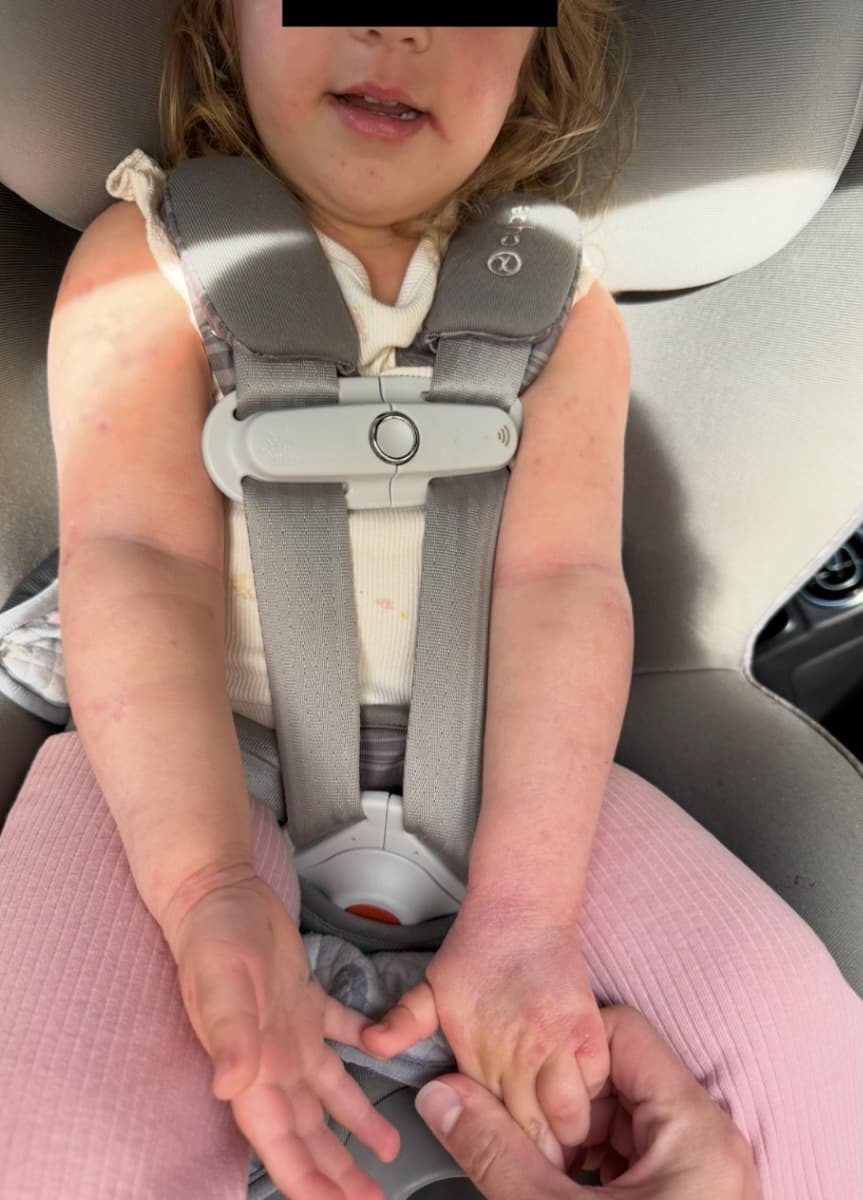
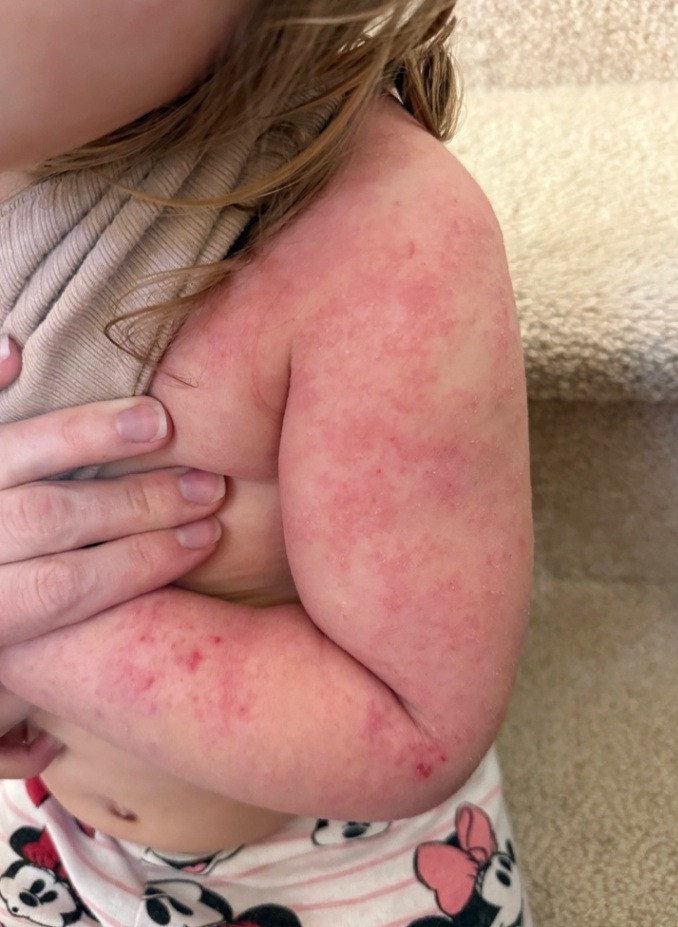
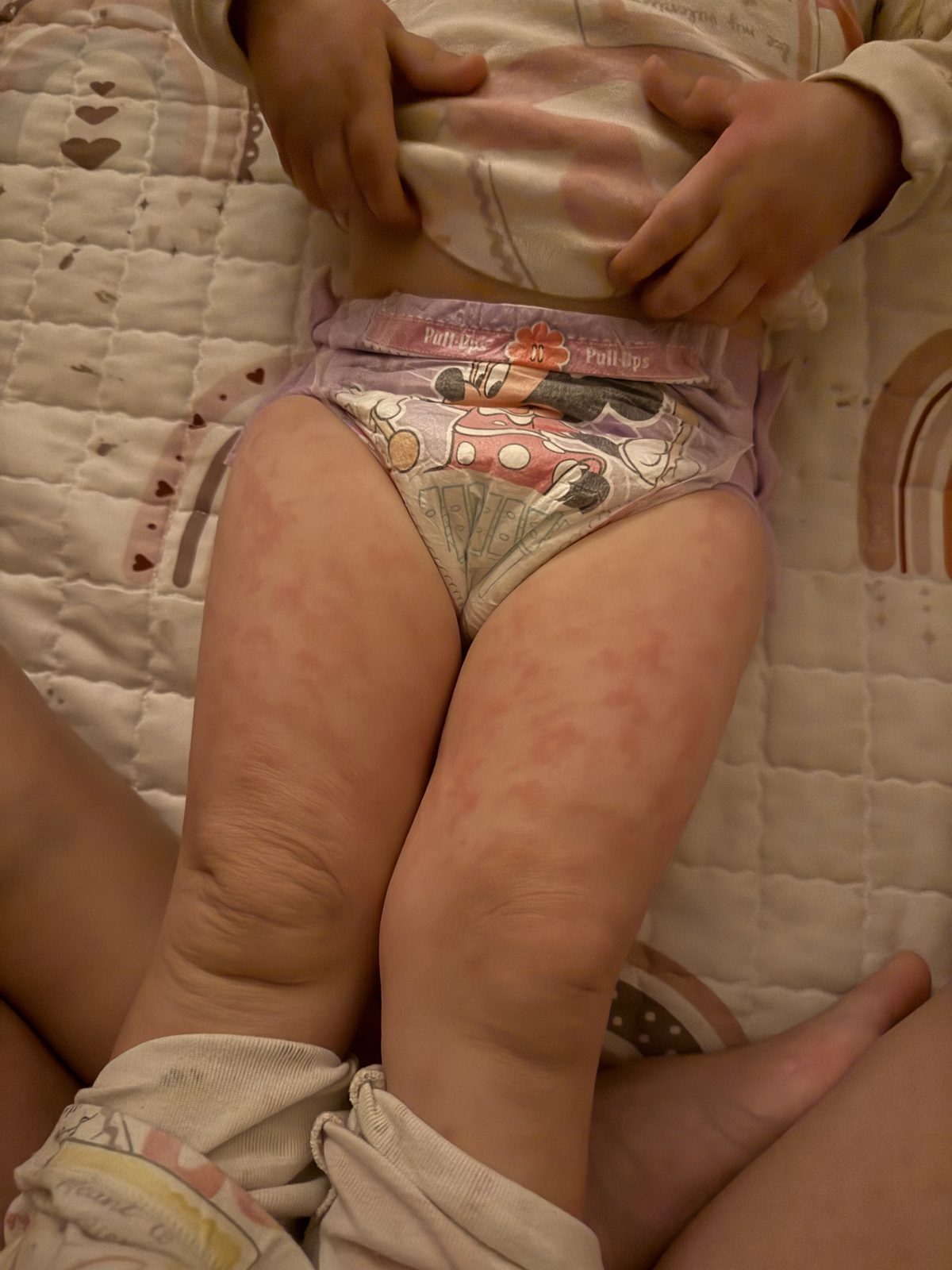
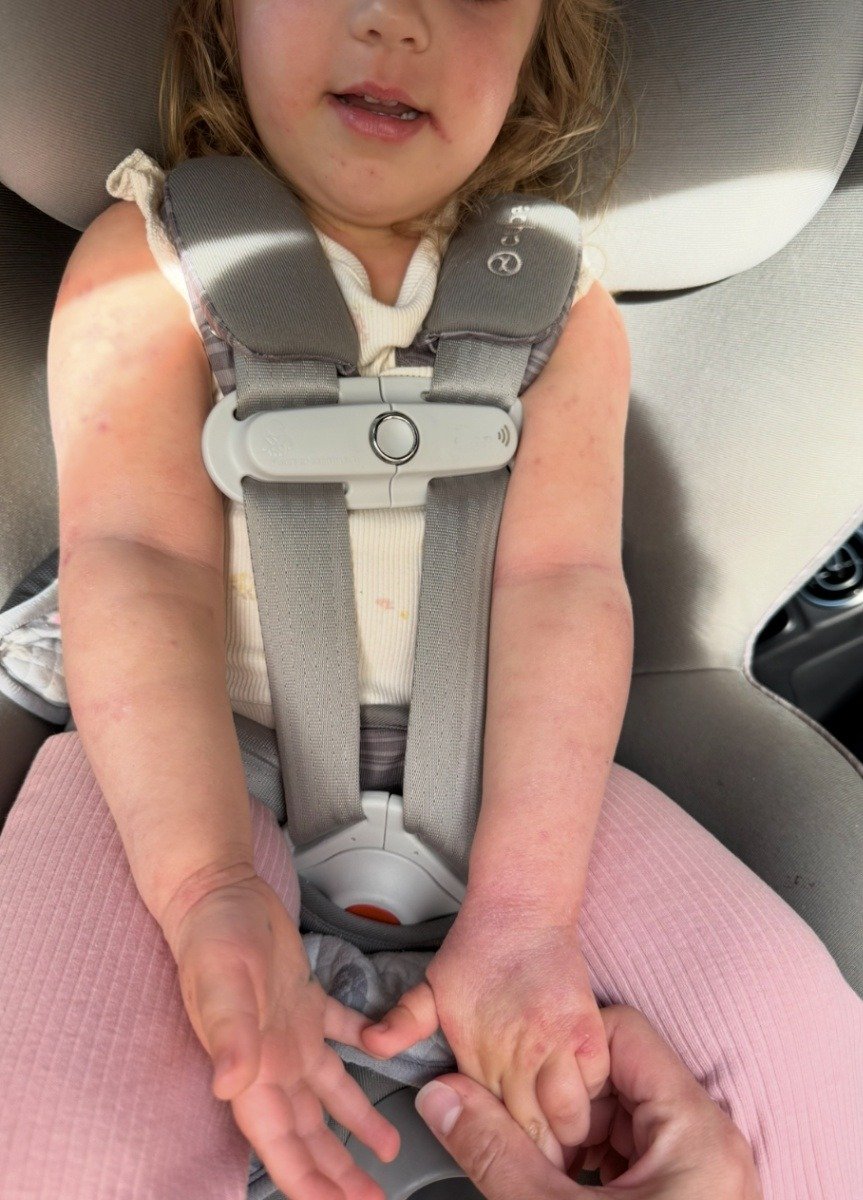
"I haven't slept still and I'm getting sick... she started having some weird rash like on her face and all over her body... the only new thing was the melatonin... yesterday it got pretty bad like on her chest, her whole arms, her back, even her legs got worse, even though her legs have been like really good... her cheeks were also like all red." — Kira's mom, Feb 24 (see
w03-2026-02-24-05.jpg)
The pattern was unmistakable: a new product introduced + rash appearing within days + rapid spread + involving areas that had cleared (legs) + no other change in food or environment. This was not Kira's underlying eczema flaring. This was an acute reaction to additives in the children's melatonin product — flavored kids' melatonins routinely contain artificial colors (Red 40, Yellow 5), artificial sweeteners (sucralose, sometimes xylitol), natural and artificial flavors, and citric acid. Any of these can trigger exactly this kind of reaction in an eczema-prone child.
The intervention
Stop the melatonin. Wait. Three days later (Feb 27):
"Last night her sleep was finally a little better. She only woke up around 11:30pm and slept till 7am 🙏🏻. Her rash reaction is slowly clearing. Skin is slowly getting better. She is still scratching herself, I'm wondering if it's a learned behavior now. Her left wrist was always the worst spot with really thick skin but I can see it getting better. The skin is softening." — Kira's mom, Feb 27
Three signals from one short message:
- The rash was clearing on melatonin removal alone → confirmed iatrogenic reaction
- The left wrist — the worst single spot in the case — was visibly softening → the underlying Blood Dryness pattern was responding to the herbs and diet beneath the surface noise
- "I'm wondering if it's a learned behavior now" → an astute parent observation that the scratching is partly habitual at this point, not purely itch-driven (a real phenomenon in chronic eczema cases that the literature underweights)
There was also a small parallel signal — Kira had two nights of diarrhea, and her mom suspected she had gotten blue cream (Qing Dai Gao) in her mouth. Qing Dai is mildly cooling and not toxic at small ingested doses, but it can definitely produce loose stools in a toddler. We noted it, kept the cream away from her hands, and moved on.
What this phase taught us
Three things, for clinicians:
- The protocol survived an acute insult. The rash cleared in days; the lichenification continued softening underneath. The body's containment capacity was already meaningfully better than at intake.
- Parent burnout is a clinical variable. Reaching for melatonin was a rational caregiver decision under unsustainable conditions, not a protocol mistake. The right response was to identify and remove the additive trigger — not to scold or restart.
- Ingredient lists matter even for "natural" products. A flavored supplement marketed for kids was the single biggest setback in 99 days.
Phase 4 — Transitional Re-emergence (Feb 28 – present)
Goal: continue the herbal and dietary work while Kira's body reorganizes the deeper layers of the pattern. Track new flare locations as they surface. Identify additional triggers if they appear.
By Apr 5 (Week 9-10), Kira's mom sent an honest update with photos:
"Hi, it's been up and down. Her wounds cleared up but she still is itchy and has red spots all over her body. So the eczema looks a little different now. You can see that her arms look a lot better but her back and legs have red flare ups." — Kira's mom, Apr 5
The surface story ("up and down") could be read as a stalling protocol — and that would be wrong. What's actually happening:
- Wounds (the bleeding excoriations) have cleared. The acute trauma to the skin is resolved.
- Lichenified arms — the worst chronic pattern signature — look noticeably better. The deep structural change is happening.
- New, smaller flares are surfacing on previously clear areas. The pattern is moving, not failing.
- The shape of the disease has changed. We've moved from a single chronic inflammatory state to discrete, transient flares in shifting locations — the signature of a body whose Wei Qi is starting to do its job again.
This is the easiest phase to misread. The only path through a 1-2 year chronic pattern is through the disorganized middle, where old reservoirs of inflammation surface and clear in turn. The lichenified wrist softening is the most important signal: the deepest layer is responding even while shallower layers churn.
We are continuing Si Jun Zi Tang at full pediatric dose, holding Dang Gui Yin Zi at a steady dose (no escalation while transient flares are surfacing), maintaining the diet, and using Qing Dai Gao + lanolin sealing on flare spots.
The pattern at intake was multilayered. Tracking how it has evolved is part of how you know the treatment is reaching the actual disease, not just the symptoms.
| Layer | At intake (Jan 30) | After dietary clearing (Feb 6) | After herbal layer + melatonin event (Feb 27) | Current (May 9) |
|---|---|---|---|---|
| Spleen Qi Deficiency (root) | Moderate (puffy pale tongue, food-introduction onset, normal-but-shallow digestion) | Beginning support (congee, bone broth started) | Si Jun Zi Tang holding; Spleen tolerating richer Dang Gui Yin Zi | Continuing to recover; lichenification softening reflects deeper Blood production resuming |
| Blood Dryness (primary manifest) | Severe (bilateral wrist lichenification, 1-2 yr duration) | Surface dryness improving with topicals | Left wrist visibly softening — 'always the worst spot' shifting | Lichenification thinning; arms much better; thigh/back patches in transitional reorganization |
| Wind from Blood Dryness (itch) | Severe (constant, scratching to bleeding, 30-40+ excoriations) | Mobilization phase — transient itch increase as Damp-Heat moved out | Reduced; partly residual learned behavior | Moderate residual; no bleeding wounds |
| Residual Damp-Heat at skin level | Lingering (dull red, steroid rebound history) | Being mobilized off the surface (transient itch flare) | Calming with Indigo + Purple Cloud topicals | Transient re-emergence in new locations as deeper layers reorganize |
| Liver Heat (emotional component) | Moderate (scratches more when upset, tantrums, irritability) | Recognized; chrysanthemum-goji tea added | Tea daily; stable | Stable on chrysanthemum-goji + bedtime breastfeeding ritual |
| Wei Qi damage (antibiotic + steroid) | Confirmed by Tiny Health test + steroid rebound history | HMO probiotics continued; LGG probiotic added | Rebuilding | Substantially better — body containing acute insults (melatonin reaction cleared in days, not weeks) |
| Heart Fire / Shen | Mild (sleep disruption emerging) | — | Stable; bedtime breastfeeding maintained as calming ritual | Stable; sleep gradually improving |
| Yin depletion | Latent — tongue had adequate moisture | Stable | Stable | Stable — Sheng Di in Dang Gui Yin Zi is preventive |
The pattern has unwound from the surface inward, with the lichenified wrist — the deepest manifestation — being the slowest and most important to shift. The melatonin event is the only place the protocol stumbled, and it stumbled on something we couldn't have planned for.
Outcomes (as of Day 99)
| Metric | Initial | Current | Change |
|---|---|---|---|
| Body surface area affected | ~35% (wrists, hands, both forearms, scattered torso/back) | ~12% (transient flares on thighs, back, face; arms much improved) | ~66% reduction |
| Wound presence | 30-40+ bleeding excoriations | Wounds cleared | Resolved |
| Lichenification (left wrist) | Severe — 'always the worst spot' | Visibly softening since Feb 27 | Substantial improvement |
| Itch severity | Severe — scratching to blood, waking to scratch | Moderate residual; partly habitual | Substantial reduction |
| Sleep (mom + child) | Severely disrupted; mom approaching breakdown | Improving — Feb 27 only one wake at 11:30pm to 7am | Substantial improvement |
| Steroid use | OTC hydrocortisone (rebounded) | None since Day 1 of protocol | Eliminated |
| Identified triggers | None known | 4 confirmed (cow's dairy, beef tallow topical, camphor cream, flavored melatonin additives) | 4 triggers characterized |
| Protocol consistency through caregiver burnout | — | Held through 4-night sleep crisis + acute melatonin flare | Maintained |
| Active herbal protocol | None (previous Xiao Feng San discontinued) | Si Jun Zi Tang + Dang Gui Yin Zi (pediatric dose) | — |
| Days on protocol | — | 99 | — |
| Phase | — | Phase 4 — Transitional Re-emergence | — |
Parent quotes (chronological)
Feb 2 — Day 4: "I have been giving her meat stock from chicken back & neck (I read that meat stock is better than bone broth for compromised gut). I try to give it to her every day and some days she drinks a whole cup and some days only a few sips." — Kira's mom, on what she was already doing well
Feb 2 — Day 4: "Also, I saw that the protocol recommended the blue cream for really bad symptoms and while bleeding, so I actually already ordered that one since she has been bleeding in quite a few spots." — Kira's mom, surfacing initiative on Qing Dai Gao
Feb 6 — Day 8: "Updates on her skin, it has been looking better visually, her wounds are healing and skin looks a lot more nourished — not dry/scaly anymore. Her legs were less affected before and now they look almost normal." — the inflection-point quote, before any internal herbs had even arrived
Feb 6 — Day 8: "I just gave her rice water today for the first time. Also got black sesame seeds and mixed in her rice at dinner."
Feb 19 — Week 3: Photos sent showing significant improvement in wrist and forearm presentation (see
w02-2026-02-19-04.jpg)
Feb 24 — Day 26: "She started having some weird rash like on her face and all over her body... the only new thing was the melatonin... it got pretty bad on her chest, her whole arms, her back, even her legs got worse, even though her legs have been like really good." — Kira's mom, surfacing the iatrogenic flare
Feb 27 — Day 29: "Her left wrist was always the worst spot with really thick skin but I can see it getting better. The skin is softening." — the deepest-pattern signal that the herbs were reaching the root (see
w04-2026-02-27-06.jpg)
Apr 5 — Week 10: "It's been up and down. Her wounds cleared up but she still is itchy and has red spots all over her body. So the eczema looks a little different now. You can see that her arms look a lot better but her back and legs have red flare ups." — the honest mid-protocol report that captures the transitional re-emergence phase exactly (see
w09-2026-04-03-07.jpg,w09-2026-04-05-08.jpg)
What's next
We are in the transitional re-emergence phase of a chronic 1-2 year pattern. The remaining work:
- Continue Si Jun Zi Tang as the foundational Spleen tonic for a minimum of 12-16 weeks total. Spleen tonification has no shortcut.
- Continue Dang Gui Yin Zi at pediatric dose for the full 8-12 week initial course. The lichenified wrist is the bellwether — when it normalizes in texture, we step down.
- Keep dairy fully out for a minimum of 6-8 more weeks, then reintroduce in staged order: eggs first, wheat second, goat dairy third (only if skin is significantly improved), cow's milk dairy last. Many children with this pattern can eventually tolerate goat dairy but never recover full tolerance for cow's milk.
- Maintain dietary structure: warm cooked food, congee + bone broth daily, no cold/raw, no shellfish, no refined sugar. Walnuts, pumpkin seeds, black sesame, jujube, and goji as ongoing therapeutic foods.
- Topicals: Indigo for acute red flares, Purple Cloud on lichenified areas, pure lanolin as the maintenance sealant as Heat recedes, shea butter for daytime. No beef tallow. No camphor.
- Avoid all flavored kids' supplements without ingredient review.
- Continue HMO probiotics + add LGG (the strain with the strongest pediatric atopic dermatitis evidence base). Re-test Tiny Health at 6 months would be informative.
- The left wrist is the case's true outcome marker. Full normalization of texture may take 3-6 more months — that's the realistic horizon for "fully through this."
- Phase out bedtime breastfeeding gradually as Kira's sleep regulation returns. No rush.
- If a sustained plateau occurs, escalate to a custom decoction tailored to the constitution as it stands at that moment, plus a fresh tongue photo.
Total expected horizon: 6-9 months from start given the chronicity at intake. We are ~3.5 months in. Another 3-5 months of active work before considering full taper.
What this case adds to the cohort
Kira's case is the cohort's bridge from infant to toddler treatment:
- A different primary pattern. Where Poppy was Damp-Heat-dominant, Kira is Blood Dryness-dominant. Together they demonstrate that "infant eczema" is not one thing — pattern differentiation shapes everything from formula choice to topical strategy.
- Direct internal herbs become possible at 2-3 years. The herbal toolbox opens in a way that simply isn't available at 3-6 months.
- The "wrong formula at the wrong stage" lesson. Xiao Feng San wasn't a bad call in principle — it was stage-mismatched. Pattern evolves; the formula has to evolve with it.
- Caregiver burnout is a clinical variable. Several decisions here were calibrated to sustainability, not just clinical optimum.
- Iatrogenic insults from "natural" supplements are real. Flavored kids' melatonin produced the single biggest setback in 99 days.
- Transitional re-emergence is not regression — wounds cleared, deep patches softening, transient new flares surfacing in shifting locations is what the middle of a chronic-pattern reorganization actually looks like.
Body surface area: Estimated by clinical observation from photos (intake Jan 29, follow-up Feb 19, Apr 5). Initial ~35% reflects forearms, hands, scattered torso/back. Lower than Poppy's case because Kira's pattern was Blood Dryness with focal lichenification rather than diffuse Damp-Heat oozing — smaller area but more chronically established.
Flare duration: Pre-protocol described as effectively continuous over 1-2 years with no clear flare boundaries. Post-protocol flares are discrete 3-7 day events resolving and re-emerging in different locations.
Itch and sleep: Self-reported by parents at intake (Tally form) and at each follow-up via iMessage / voice memo.
Steroid use: Self-reported. No verification of dispensing records.
Herbal differential audit: Three classical formulas were considered (Si Wu Tang, Xiao Feng San, Dang Gui Yin Zi). Reasoning is documented in the practitioner clinical archive.
Limitations: This is documented clinical practice, n=1. Estimates were not done with a validated scoring instrument (POEM, SCORAD, EASI). Parent communication was iMessage / voice memo rather than a structured weekly check-in form — some quotes are paraphrased from voice memos. Going forward, this case will be re-scored prospectively using POEM.
Disclaimer & consent
The information on this page describes clinical practice with a single client and is shared with explicit parental consent. It is not medical advice, and individual results vary. Traditional Chinese Medicine works alongside, not in replacement of, conventional pediatric care. Names and identifying details have been changed to protect the family's identity. Photographs are published with parental consent and have been redacted (eyes covered, identifying chest features covered) to preserve anonymity.
This is documented clinical practice, not a controlled study.
For questions about this case or to discuss your own baby's pattern, contact Weston Willingham at weston@getcentered.health.