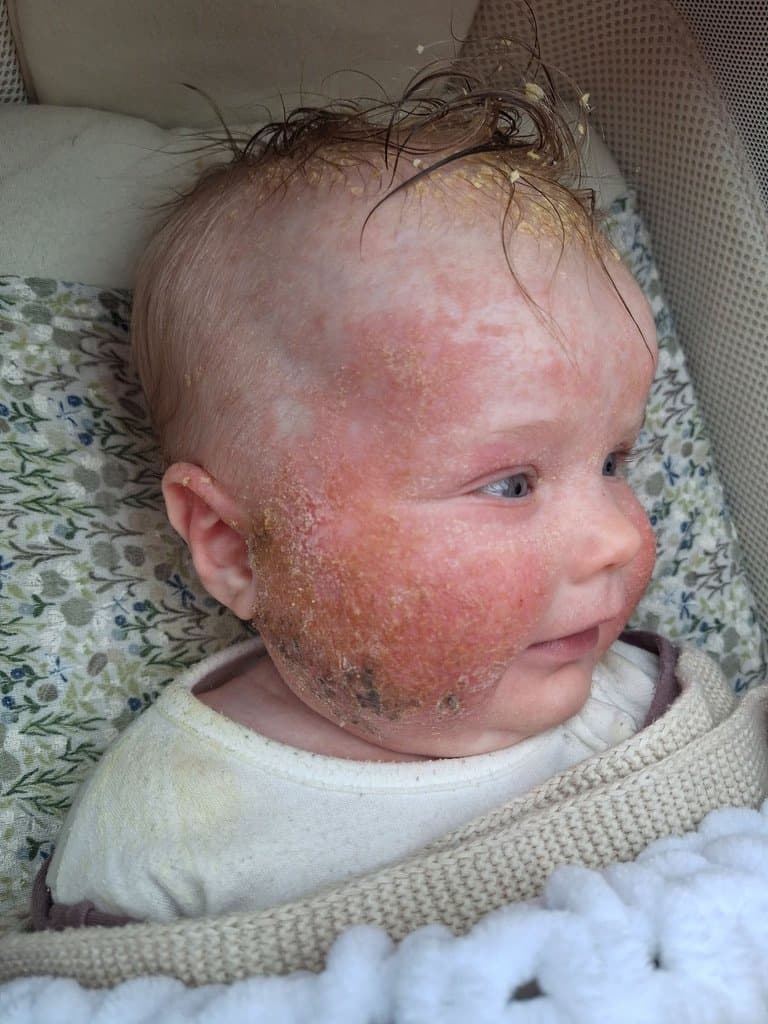
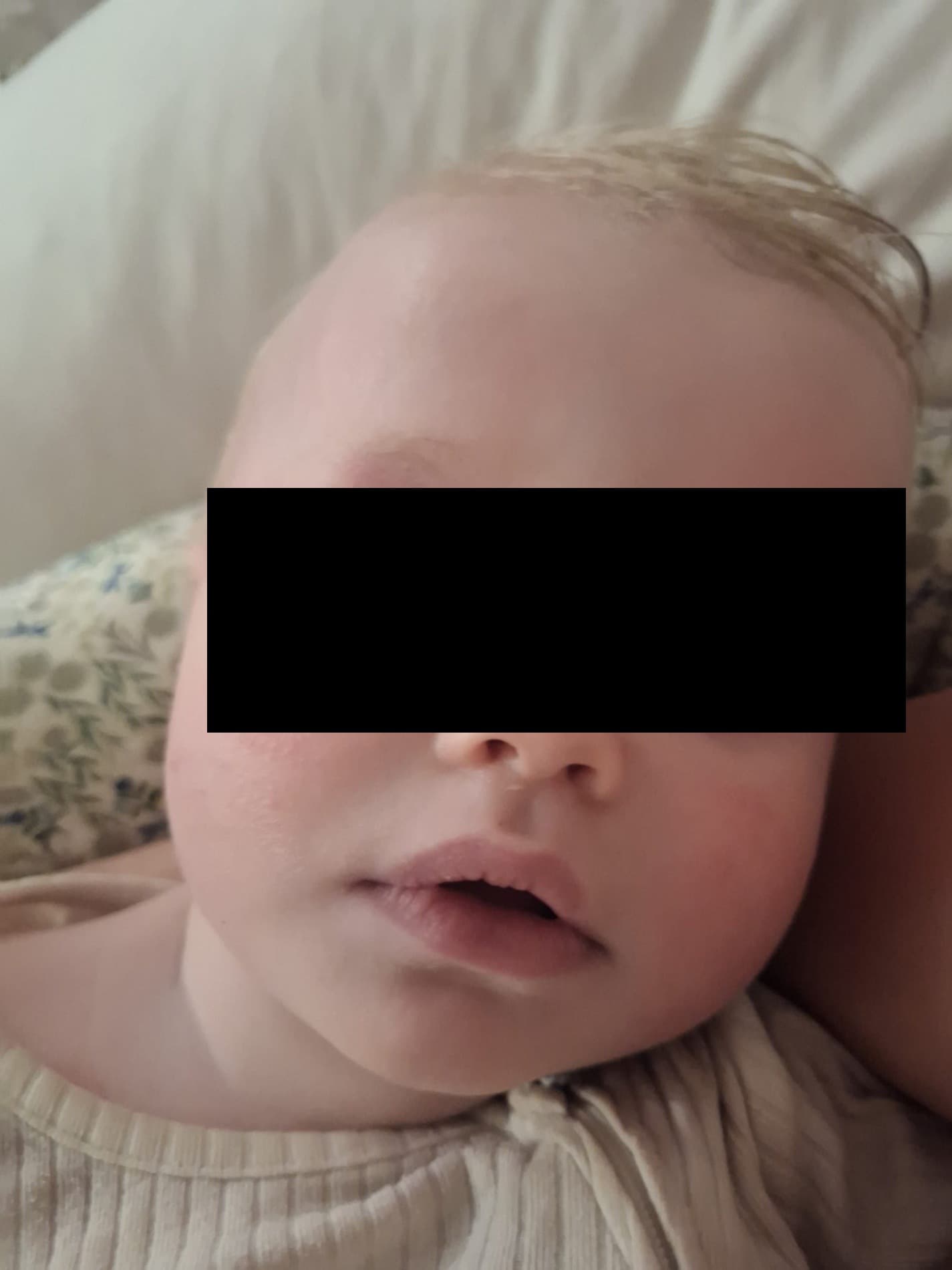
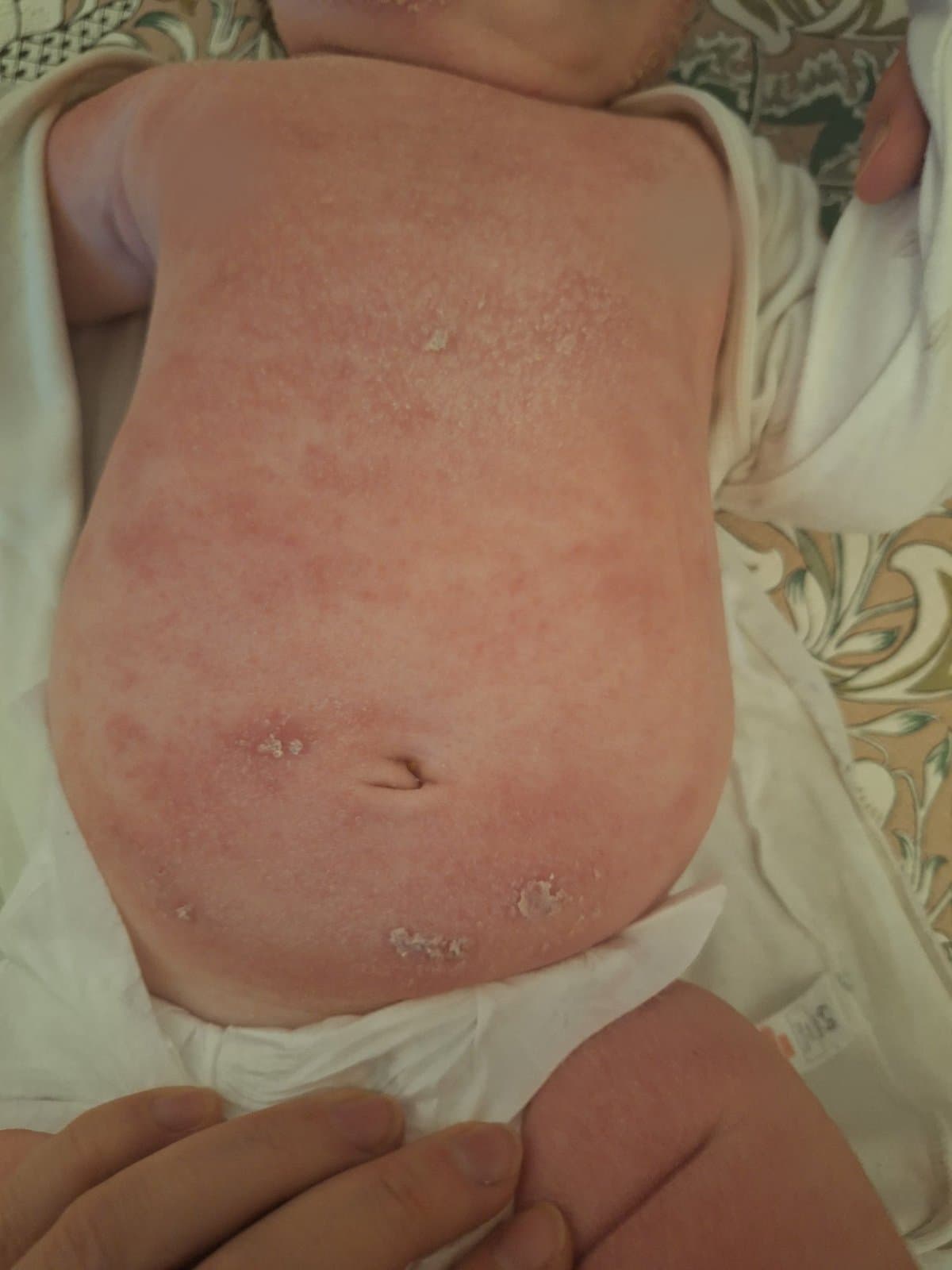
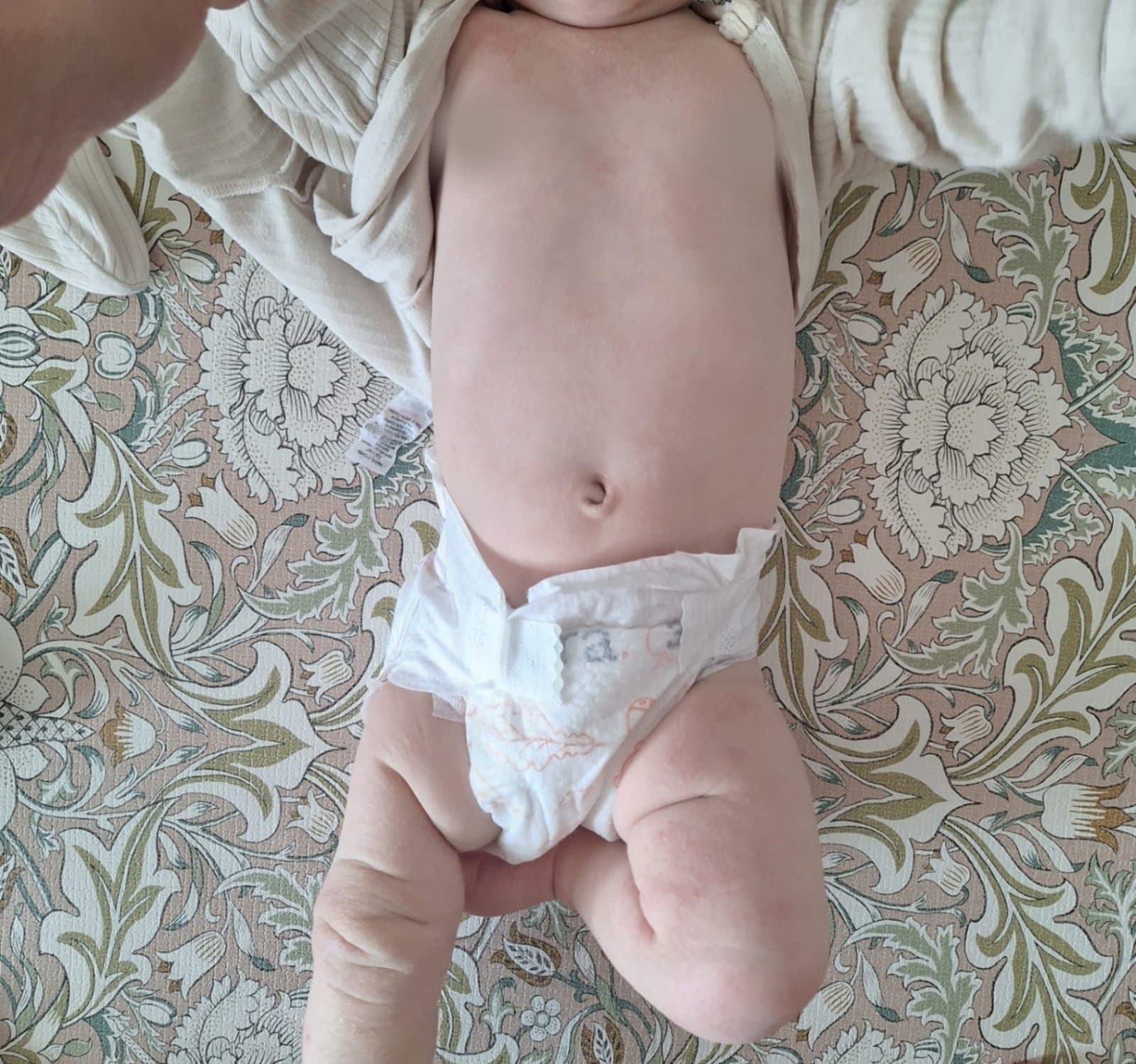
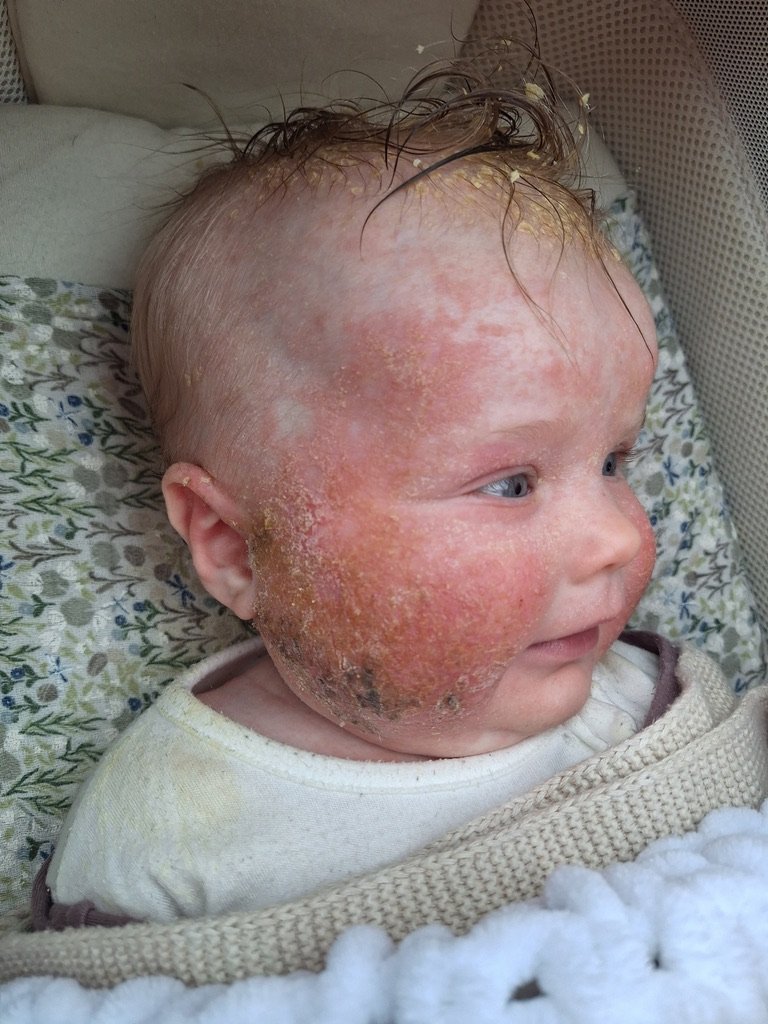
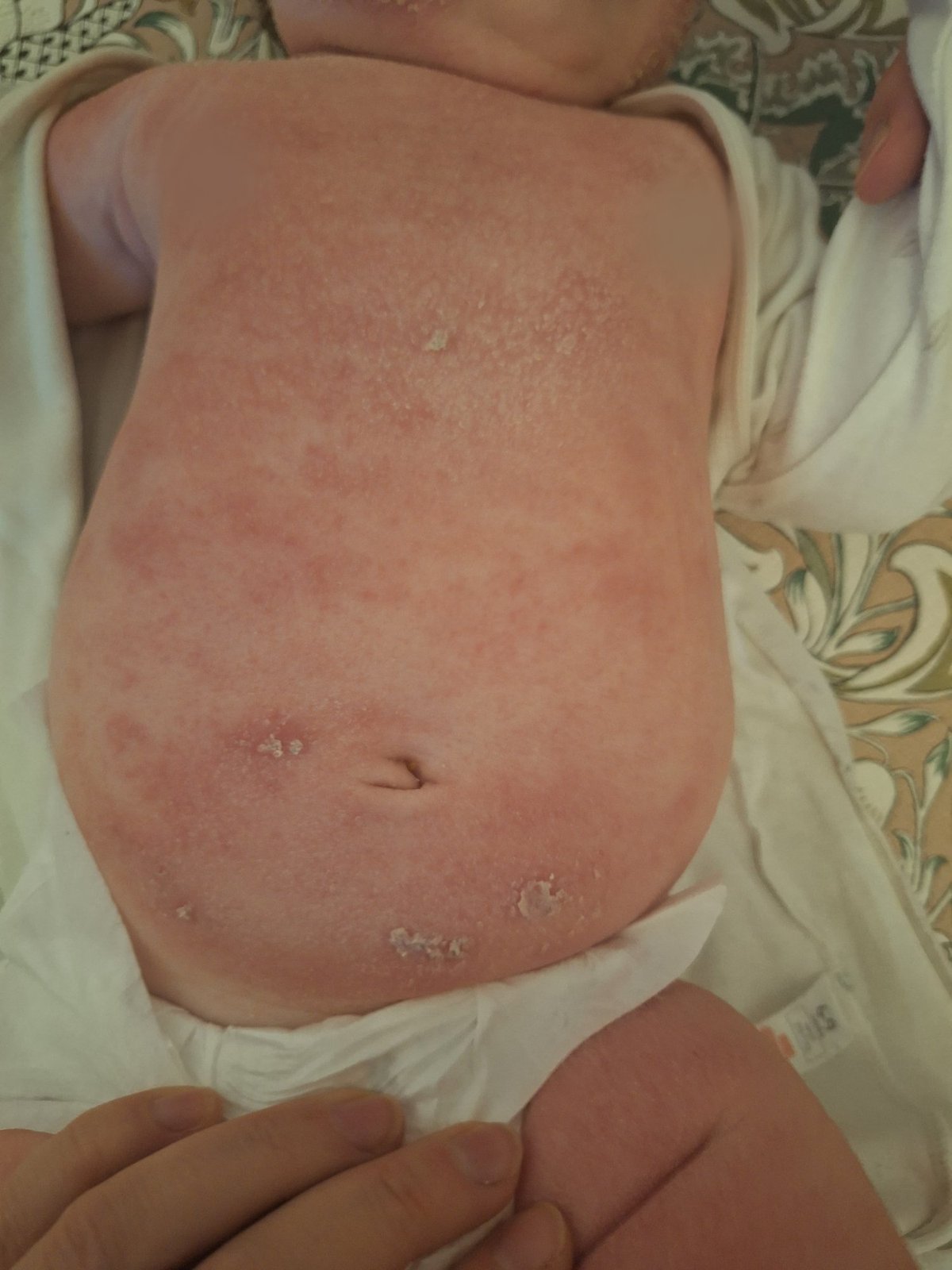
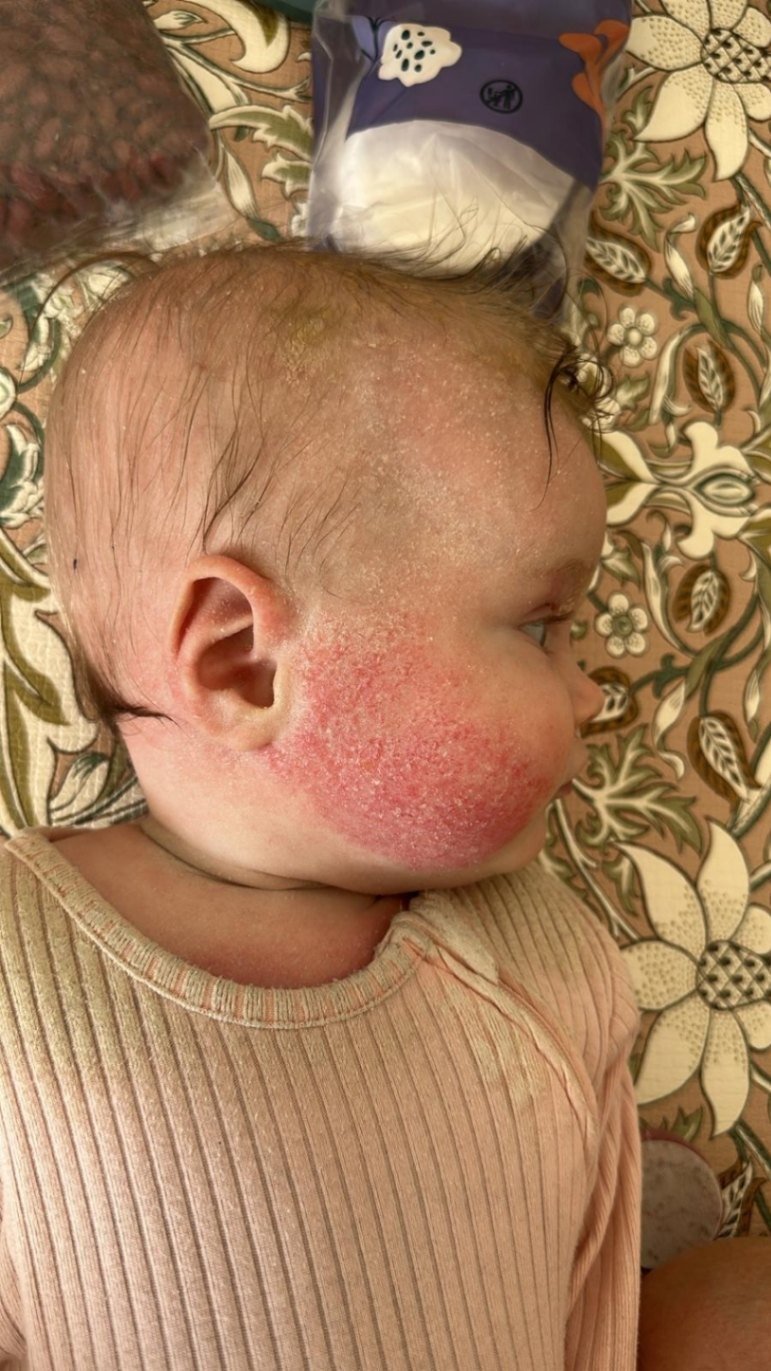
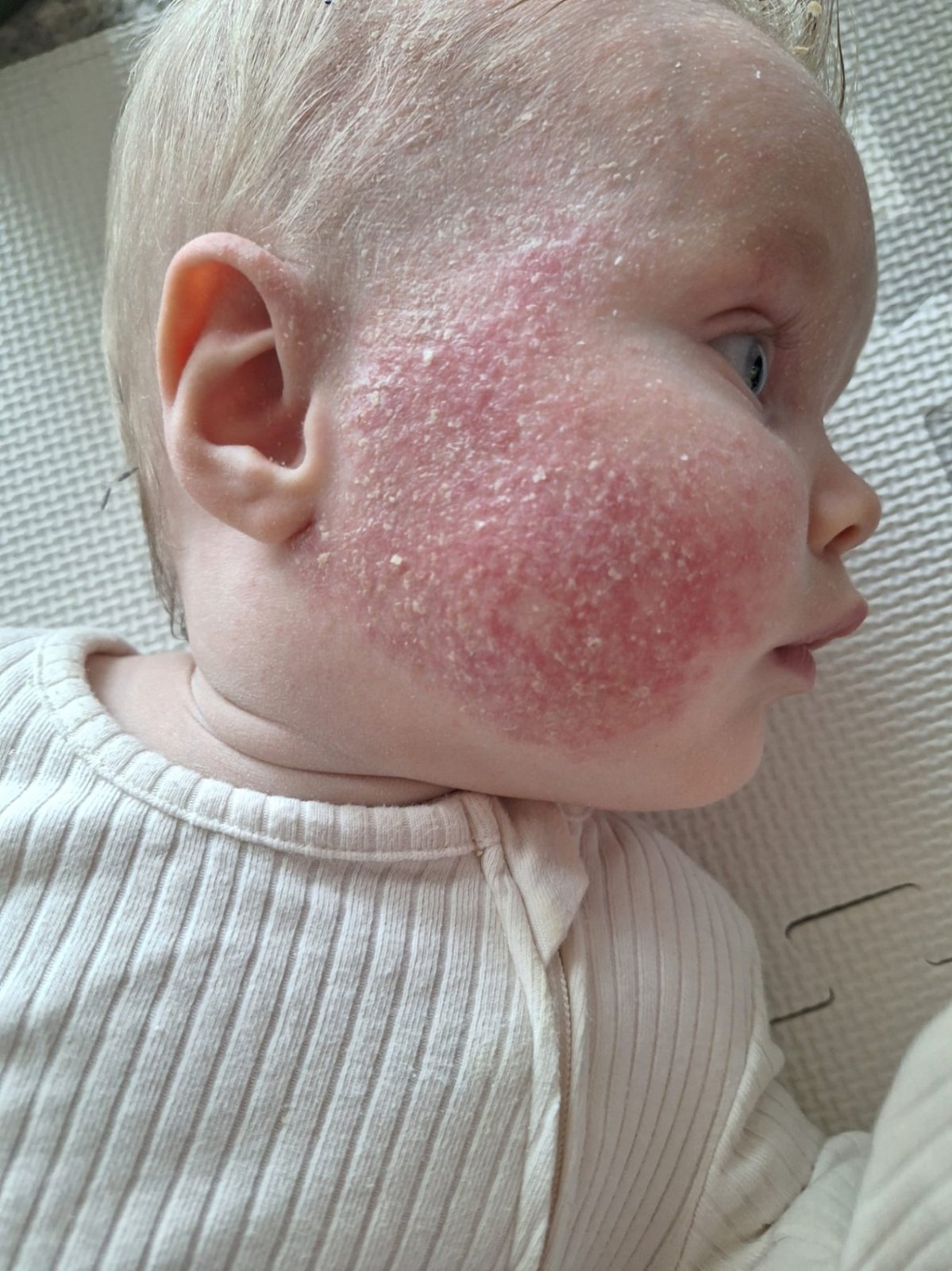
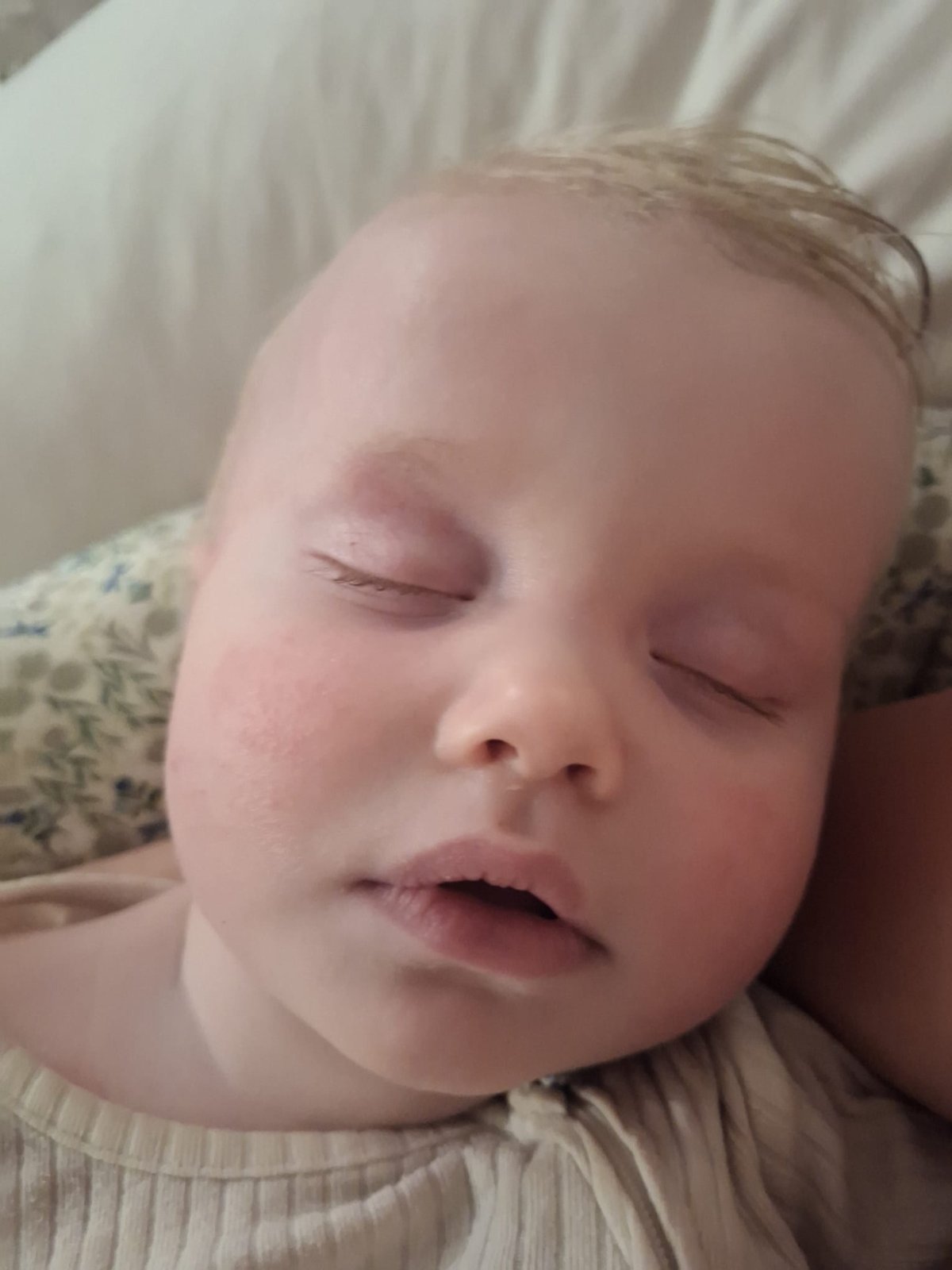
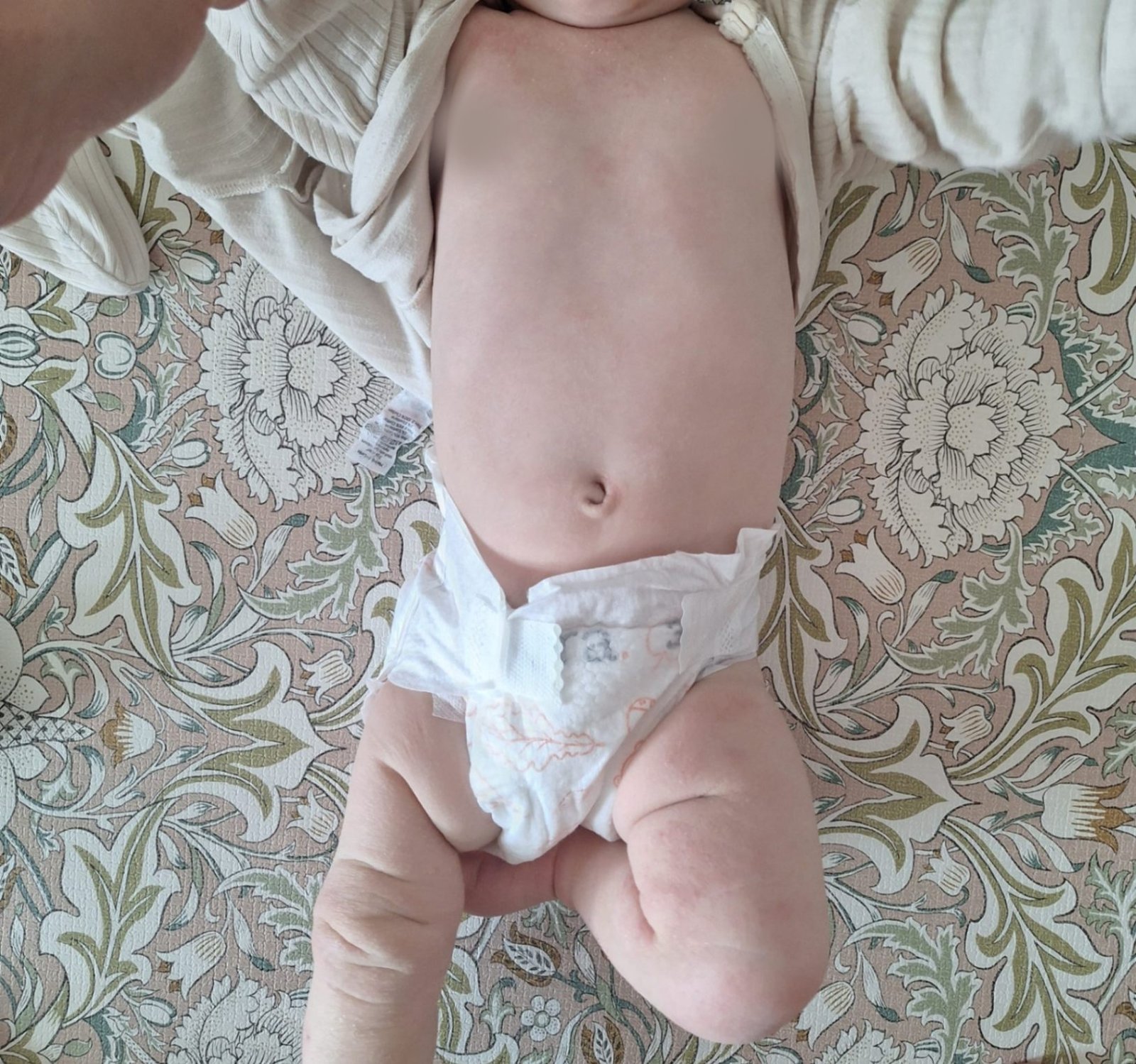
3-month-old, exclusively breastfed, UK-based, presenting at 60-75% body surface area in the top 5-10% severity range for infantile eczema. Pattern: Spleen Deficiency with Damp-Heat Toxin Flooding the Skin. A phased dietary, topical, and herbal protocol carried her to functionally clear skin — but the decisive turn came from an unexpected place: recognizing that the mother's stress, generated by the very elimination diet meant to help, had become a driver of the baby's eczema. When we freed the mother and released the diet, the baby improved. Nineteen weeks in, she is off all treatment, off all dietary restriction, and — photographed asleep during a heatwave that would once have triggered a 10-day flare — functionally clear.
At a Glance
When Poppy's parents reached me on February 23, 2026, she was three to six months old, exclusively breastfed, with bright red oozing eczema covering an estimated 60-75% of her body — face, scalp, torso, limbs, behind the ears. She was scratching herself to the point of drawing blood. Topical steroids had worked briefly, then she rebounded worse. Her parents had already spent £500-1,000 trying everything — dermatology, an elimination diet for the breastfeeding mother, a hair mineral test that had flagged specific food sensitivities, and a constellation of OTC creams. They were exhausted.
The pattern was textbook-clear: Spleen Deficiency Generating Dampness with Damp-Heat Toxin Flooding the Skin (脾虚湿蕴,湿热毒邪外溢肌肤). Initial AI-assisted pattern confidence was 0.92 — significantly higher than my typical 0.85 baseline. By Week 2, the thick yellow facial crusts were gone and Poppy's father wrote me: "I feel very positive and confident moving forward — for the first time." By Week 6, her stools had transitioned from green/watery to yellow-brown — a textbook sign of Spleen function recovering. By Week 8 we attempted to add herbal escalation through her mother's breastmilk; the cooling formula didn't suit her mother's depleted Stomach Yin, and we pivoted to a gentler backup formula we had bought preemptively for exactly this scenario.
Then the case taught me its most important lesson — one that changed how I now treat every breastfeeding mother. Around Week 14-16, Poppy's mother, Lucy, quietly reached her limit. The strict elimination diet — correct and necessary in the acute phase — had by now become the primary source of her own stress, and in Traditional Chinese Medicine terms, that maternal stress (Liver Qi stagnation generating constraint-Heat) transmits to the baby through the milk. Lucy stopped the diet because she had to. And Poppy's skin improved. The intervention had, by that point, become part of the pathogen.
We had already put Lucy on a Liver-coursing formula (Jia Wei Xiao Yao San — "Free and Easy Wanderer Plus"). Within weeks of freeing her Liver Qi, she made the decisive, self-protective choice to eat freely again — and the whole family softened. As of the most recent photos (July 9, Day 133), Poppy is off all herbs, off all topicals, and off all dietary restriction. Her skin is functionally clear. A UK heatwave — heat was one of her original flare triggers — produced only a faint transient cheek flush. Her mother's words say it best: "if this was a few months back she would have been a whole lot worse."
She has not used a steroid since the protocol began.
Presenting Picture
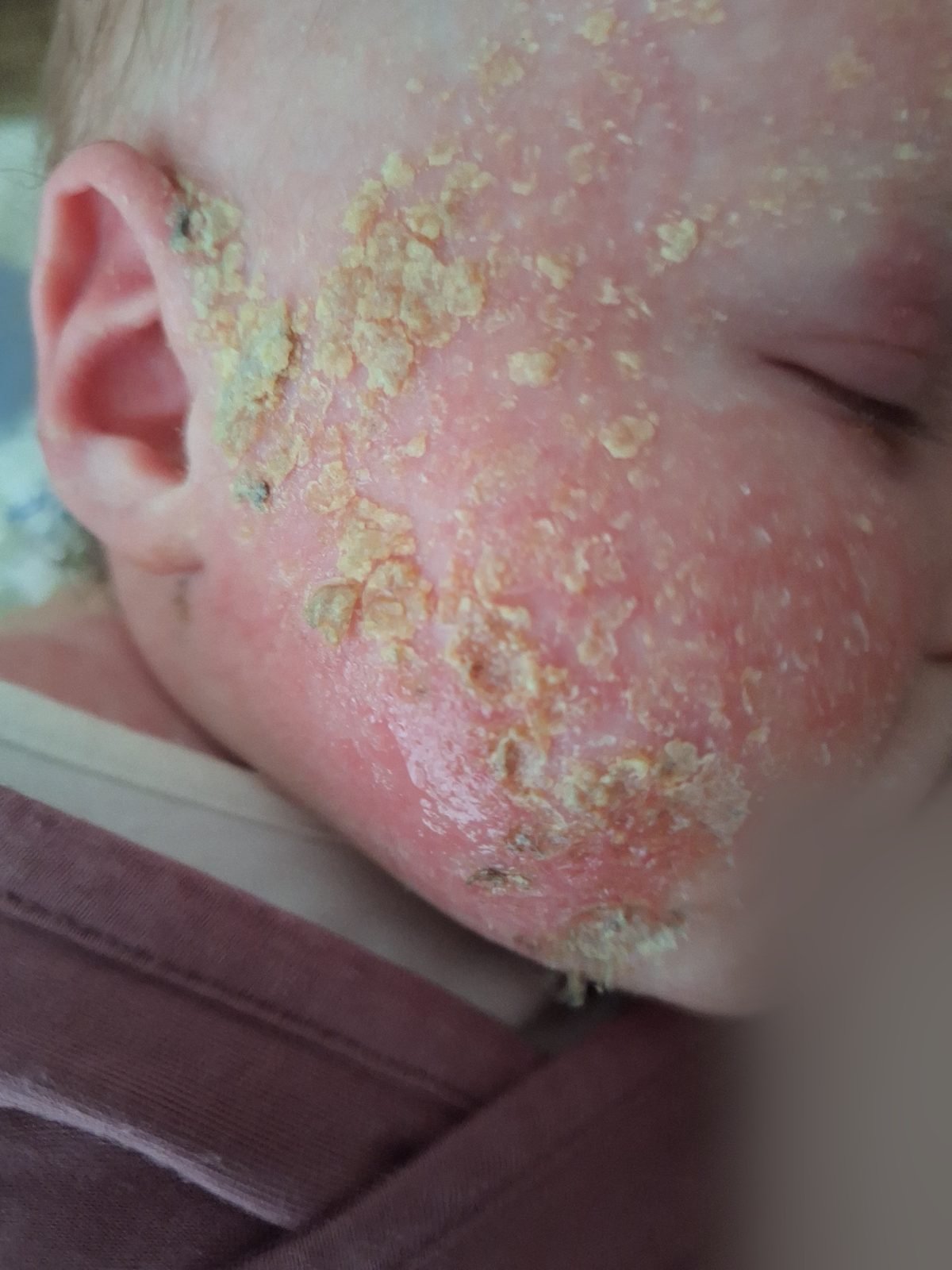
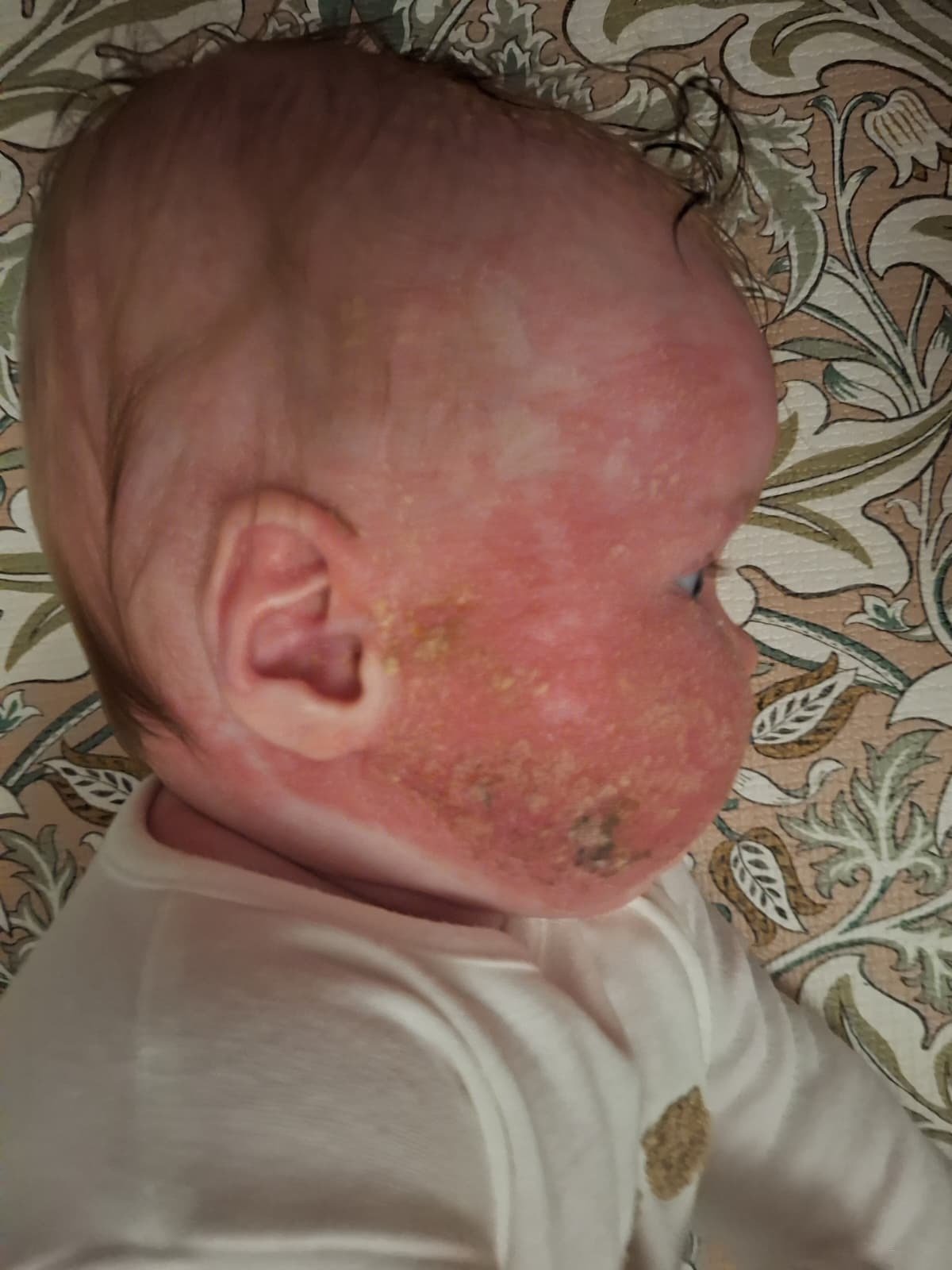
Poppy's eczema started before she was 3 months old. By the time her parents reached me, the picture was severe enough to be in the top 5-10% of infantile eczema cases I see. From the initial intake and photos:
- Skin: Bright red, hot-to-touch erythema across face, torso, limbs, behind the ears, and scalp. Thick, multi-layered honey-colored crusts on both cheeks with active weeping beneath. Possible secondary bacterial impetiginization of the cheek lesions. Greasy yellow scalp plaques (cradle cap). Retroauricular fissuring with sticky exudate. Dorsal hand showed a denuded erosion. Estimated 60-75% body surface area involved.
- Itch: Severe. Scratching constantly. Waking to scratch. Drawing blood.
- Sleep: Severely disrupted for both Poppy and her mother.
- Digestion: Loose/watery stools most of the time. Frequent bloating and gassiness after feeds. No undigested food, no spit-up.
- Mood: Affecting baby's temperament. Parents exhausted.
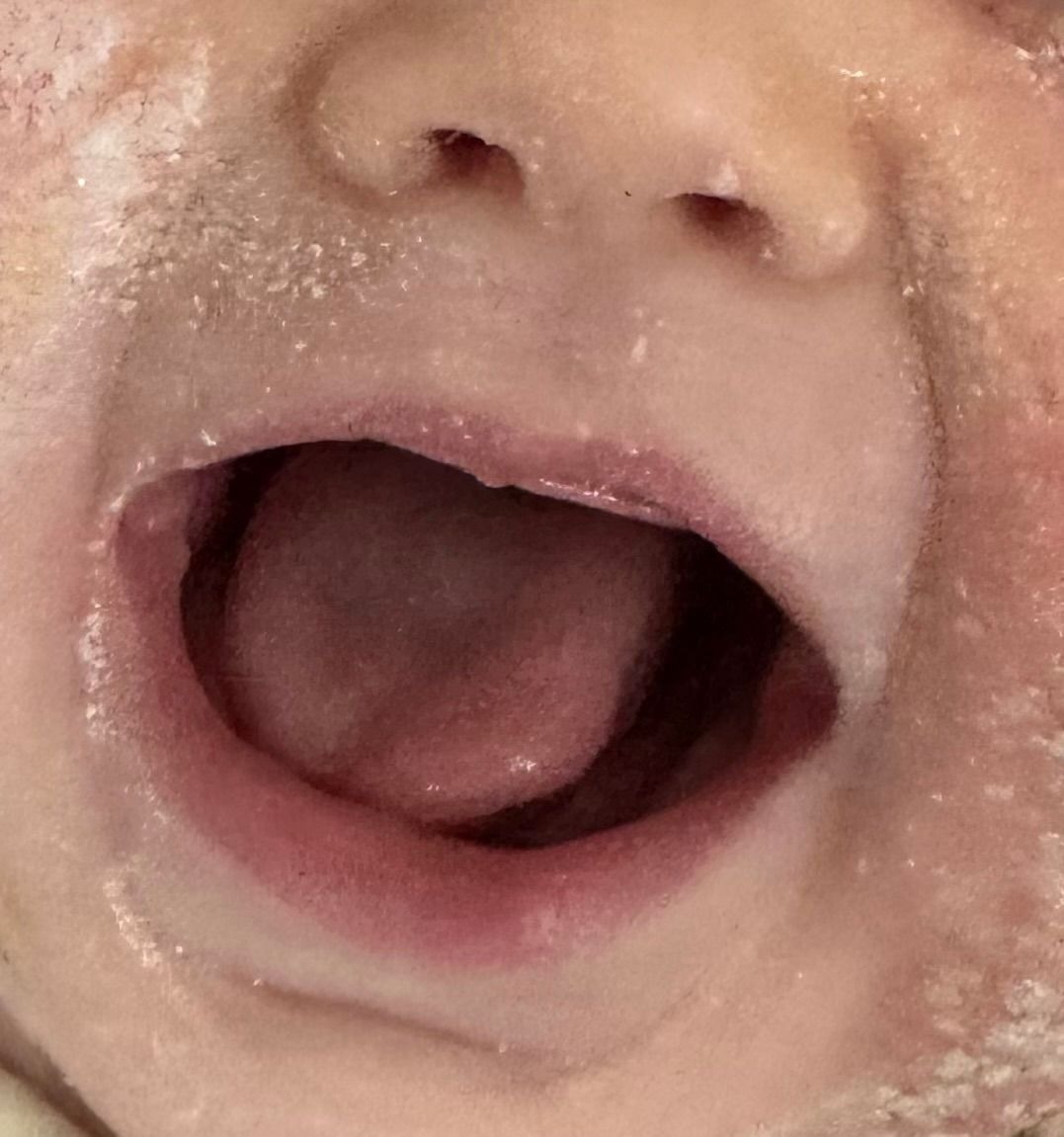
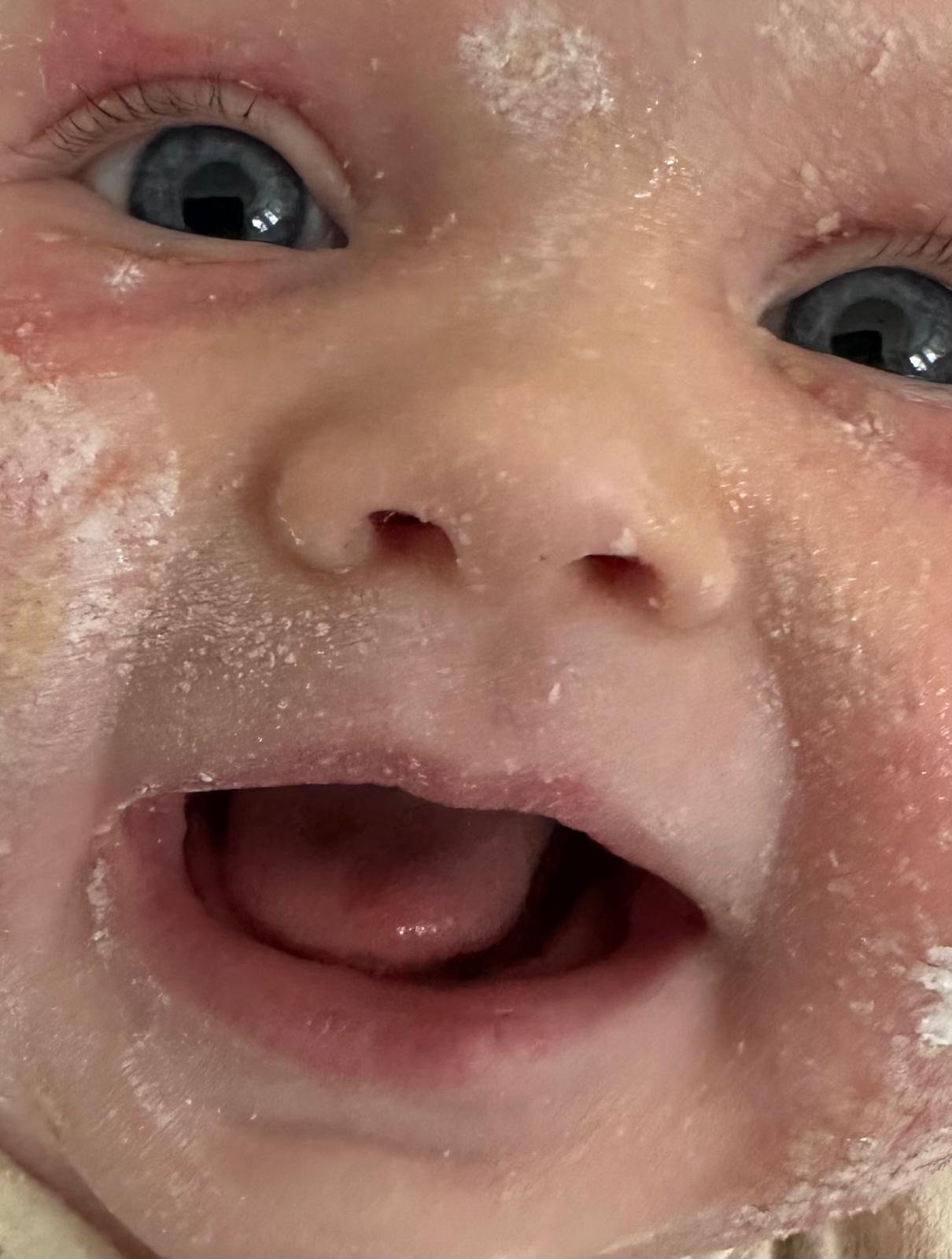
- Tongue: Swollen, puffy, excessively moist. Greasy white-to-yellow coating, thickest at center (Spleen/Stomach zone). Body redder than infant baseline, redder at tip. Deep crimson-violet undertones at the cheek bases (signaling Heat penetrating to the Blood level).
Heat aggravation confirmed: warmth made everything worse. (Hold onto this detail — it becomes the natural stress-test that closes the case.)
What They'd Tried
Before reaching out:
- Prescription topical steroids (worked temporarily; rebounded worse on withdrawal)
- Elimination diet for the breastfeeding mother (already removed dairy 4 months prior to intake)
- Dermatology consultation
- A hair mineral test showing food sensitivities — this would prove unexpectedly important later
- An OTC TCM-formulated cream (the "Blue Skin cream" — discussed below) that had cleared her once before but kept letting her relapse
- Approximately £500-£1,000 spent
Steroid rebound was central to the picture. In TCM terms, the suppressive treatment had pushed pathogenic factors deeper inward and damaged Poppy's Wei Qi (defensive Qi), creating a self-reinforcing cycle: weaker defenses → more pathogen reaching the skin → stronger suppression needed → further weakened defenses. Breaking that cycle was a treatment goal in its own right.
Three independent diagnostic streams — tongue, intake history, and presenting skin — converged on a single internally consistent pattern. A fourth stream — the family's own prior hair mineral test — was integrated in our Day-3 sync call and added a layer of food-specific intolerance data.
Tongue findings
- Body shape: Swollen and puffy, filling the oral cavity → primary sign of Spleen Qi Deficiency with fluid accumulation
- Coating: Greasy white-to-yellow, thickest at the center (Spleen/Stomach reflection zone) → Dampness localized to the Middle Jiao, transforming toward Damp-Heat
- Surface: Excessively moist, glistening → Spleen failing to transform fluids
- Color: Pink-red, redder than infant baseline, redder at the tip → internal Heat rising upward; Heart involvement (the tip reflects the Heart)
- Cheek-base undertones: Deep crimson-violet → Heat has penetrated to the Blood level (营血分热)
Intake red flags
- Bright red, hot-to-touch presentation — Heat at both Qi and Blood levels
- Loose/watery stools most of the time, no undigested food — moderate Spleen Qi Deficiency, not collapsed
- Frequent bloating after feeds — Qi stagnation in the Middle Jiao from Dampness obstruction
- Heat aggravation — confirmed Heat as a dominant pathogen
- Steroid rebound — Wei Qi damage; pathogen pushed deeper
- Onset before 3 months with rapid progression — implicates Fetal Toxin (胎毒) as a constitutional layer
- Scratching to bleeding — Wind generated from Blood-Heat (血热生风)
Hair mineral test integration
Poppy's parents brought their own prior testing — a hair mineral test that had flagged specific foods as potentially intolerant for her. This is data I take seriously. Even if the methodology is debated in conventional medicine, intuitive parents with sufficient resources to commission such a test usually have other signals indicating the same thing. Integrated into the analysis. Notably: chicken was on the flagged list. This would prove predictive 10 weeks later (see Phase 4 below).
Triangulation
The Spleen tongue signs (swollen, moist, greasy center) confirmed the root (Spleen Qi Deficiency producing Dampness). The yellow oozing crusts confirmed the manifest form (Dampness combined with Heat erupting outward as Damp-Heat Toxin). The bright-red erythema and Heat aggravation confirmed the Heat severity at the Qi level. The deep crimson cheek-bases and bleeding from scratching confirmed Heat had reached the Blood level. The relentless itch confirmed Wind generated by Blood-Heat. The early onset and severity at 3-6 months implicated Fetal Toxin as a constitutional predisposing factor. The steroid rebound implicated Wei Qi damage layered on top.
The pattern was not ambiguous. Every diagnostic stream pointed to the same place.
Primary pattern
Spleen Deficiency Generating Dampness with Damp-Heat Toxin Flooding the Skin Pi Xu Shi Yun, Shi Re Du Xie Wai Yi Ji Fu — 脾虚湿蕴,湿热毒邪外溢肌肤 Confidence: 0.92
Secondary patterns
- Fetal Toxin (胎毒) — early-onset constitutional Heat-toxin
- Wind-Heat Entering the Blood Level (风热入血分) — driving the relentless itch
- Early Blood Stasis from Prolonged Heat (热灼血瘀,初期) — visible at jawline; not yet dominant
- Heart Fire Disturbing the Shen (心火扰神) — sleep disruption + facial predominance
- Wei Qi Damage from Steroid Suppression (卫气受损) — driving the rebound cycle
The pattern we did not name at intake — and should have weighted higher
There was a sixth layer, and it did not belong to the baby. Lucy's own tongue at intake showed early Yin/fluid depletion, a central crack, and scalloped edges — Spleen Qi Deficiency with Stomach Yin insufficiency, on a postpartum Qi-and-Blood-deficient base, with Liver Qi stagnation and constraint-Heat layered over the top. We noted it. We treated her Spleen carefully. But we treated her Liver as an afterthought — and her Liver turned out to be her dominant decompensating system, and (through the milk) a co-driver of Poppy's disease. That under-weighting is the central teaching point of this case. More below.
Treatment Strategy
Plain English (for parents)
Cool what's inflamed. Dry the dampness from the inside. Soothe and protect the skin from the outside. And rebuild the digestive engine that's generating the dampness in the first place. Each piece on its own will not work. They have to run together. Critically: the mother's own constitution must be honored at every step, because everything we change in her diet or herbs reaches Poppy through breastmilk — and, as we would learn, so does everything she feels.
Treatment principle (zhì zé) for clinicians
健脾化湿 · 清热解毒 · 凉血祛风 · 重建卫气 · 疏肝解郁(母)
Strengthen the Spleen and transform Dampness · Clear Heat and resolve Toxin · Cool the Blood and disperse Wind · Rebuild Defensive Qi · Course the Liver and release constraint (in the mother)
Three constraints shaped how this principle was operationalized:
- Poppy was too young for direct internal herbs. All internal herbal treatment had to reach her through Lucy's breast milk (maternal teas, then later maternal teapills) or through external application (topicals). Direct decoctions to a 3-6-month-old were off the table.
- The dietary lever was unusually clean. Exclusively breastfed = single input. Modify Lucy's diet → modify Poppy's input. No complicating formula or solids.
- Lucy's own constitution had to be carefully respected. Lucy's tongue showed early Yin/fluid depletion. Aggressively cooling her through cold-bitter herbs would deplete her further AND pass that depletion through breastmilk to Poppy. This shaped every herbal decision.
Maternal dietary decisions on Day 3 (Feb 26)
In our first long sync call, three foods were removed from Lucy's diet that she hadn't expected:
- Ox liver — extremely nutrient-dense and therapeutic in many contexts, but heating to the Blood level. "Like throwing gasoline on a fire" for Poppy via breastmilk. Removed.
- Red meat — typically supportive for postpartum recovery, but too rich/heavy in this context — generates internal Dampness and Heat in excess. Switched to fish and chicken.
- Implied: any spicy/greasy/fried foods — Lucy's diet was already clean of these, but confirmed.
Together these explained the persistent Heat that the family hadn't been able to source. "This was a significant contributor to the problem." The front-loaded strict diet was the right call — and the data later proved it (Week-2 improvement arrived before any herbs). The mistake was never building the off-ramp.
Phase 1 — Acute Clearing (Week 0-2: Feb 23 – Mar 11)
Goal: stop the oozing, clear the surface Heat-Toxin, halt the bleeding from scratching, and protect Lucy's stomach so she could carry the dietary load.
What we did:
- Topicals (3-tier, pattern-mapped):
- Huang Lian Gao (Coptis Ointment, 黄连膏) — face crusts, possible impetiginization, weeping cheeks. Heat-Toxin clearer. 2-3× daily.
- Qing Dai Gao (Indigo Ointment, 青黛膏) — fiery red torso and limbs. Cools Blood-level Heat. 2-3× daily.
- Zi Cao Gao (Purple Cloud Ointment, 紫云膏) — held in reserve for the transitional phase, when oozing had resolved and skin needed regeneration support.
- Lukewarm colloidal-oatmeal baths, then pat damp (never rub), apply ointment while skin is moist. Bath water no warmer than tepid — Heat aggravation.
- Maternal teas (Lucy):
- Chrysanthemum & Barley (菊花薏苡仁茶) — 6 cups daily. Chrysanthemum clears Liver Heat and calms Shen. Barley/Job's Tears drains Dampness through the Spleen. Direct effect through breast milk.
- Ginger & Jujube (姜枣茶) — 2-3 cups daily. Warms the Middle Jiao, supports Lucy's Spleen so she can carry the rest of the dietary load without depleting herself.
- Mung Bean (绿豆汤) — rescue tea on the worst flare days. The classical Heat-resolving food medicine.
- Maternal diet:
- Out: dairy (already done), red meat, ox liver, sugar, fried/spicy foods, raw/cold foods
- In: warm cooked congee with jujube dates and goji, cooked vegetables, rice, gentle proteins (white fish, chicken)
- Eat every 2-3 hours. Never long gaps. (Necessary for tea tolerance and to protect Lucy's stomach Yin from the cooling teas.)
- Environmental:
- Bedroom cooled to 18-20°C / 65-68°F (Heat aggravation)
- Cool-mist humidifier
- Cotton mittens at night to prevent scratch trauma during sleep
- Family dog rehomed (potential allergen + dander-driven Wind contributing to the picture)
A pattern check on Day 5 (Feb 28) — the "Blue Skin cream"
Poppy's parents had an existing TCM-formulated cream from a different practitioner that had cleared Poppy's skin in a week the previous time they'd tried it. They asked: should we use it now, or wait for the Coptis ointment to arrive in the mail?
I analyzed the ingredient list against Poppy's pattern. Six of eight ingredients (Ku Shen, Bai Xian Pi, and four others) were pattern-aligned. The two outliers were warming and added some risk, and the tea tree was concerning on broken skin. Verdict: use it as the interim topical with a forearm patch test first. "For ~45% of babies with eczema, that specific cream would make it much worse because their patterns don't align to it" — but Poppy's was in the small minority for whom it would help.
This is a small moment but a clinically important one: it's the same pattern-precision logic that lets one parent's "miracle cream" be another parent's flare-trigger. The parents had already directly experienced the cream working and not lasting — because it addressed the branch (Heat in the skin) without addressing the root (Spleen-generated Dampness). Poppy's father captured this himself: "I'm also guessing that it returned to her skin quickly because we weren't addressing the root cause."
Week 2 outcome (Mar 11-13)
The first practitioner check-in landed Mar 13. Poppy's mother reported (verbatim from Tally check-in):
| Question | Answer |
|---|---|
| Itch vs. two weeks ago? | Reduced a little |
| Body skin (torso & limbs)? | Better |
| New patches, or area shrinking? | Shrinking |
| Behind the ears? | Perfect, dry and clear |
| Scalp / cradle cap? | Easing |
| Stools — still green and watery? | Same |
| Bloating after feeds? | Maybe less bloated |
Two days earlier (Mar 11), Lucy noted that all the thick scabs were gone — the worst of the facial Damp-Heat Toxin had resolved. There was a brief reactive episode to one of the topicals ("prickly red dots with slight weeping") which prompted a switch from the original Chinese balm to Huang Lian Gao for the cheeks specifically.
Clinical reading at Week 2: Surface Damp-Heat clearing as predicted. Behind-the-ears clear (one of the most reliable early markers in infant Damp-Heat eczema — that fold is where Dampness pools first and resolves first). Stools unchanged at this point — expected. The internal Spleen will not budge in two weeks. That's a 6-12-week shift, not a 2-week shift. This improvement arrived on diet + topicals + maternal teas alone, before any herbal blend had shipped — which is why we know the front-loaded diet earned its keep.
A parent confidence inflection (Mar 15)
After 20 days on protocol, before any herbal blends had even arrived:
"Thank you so much for everything so far, I feel very positive and confident moving forward — for the first time." — Jody (Poppy's father), Mar 15
This is what a foundational dietary + topical + maternal-tea + environmental protocol can do before internal herbs even enter the picture. The inflection from desperation to belief.
Phase 2 — Transitional (Week 2-8: Mar 13 – Apr 17)
Goal: continue clearing residual surface inflammation, watch the digestive recovery in stool quality, and start setting up for root-level Spleen tonification through carefully dosed herbal blends introduced to Lucy.
What changed in the protocol:
- Continued topicals (with Huang Lian Gao replacing the original cheek balm)
- Continued maternal teas
- Continued maternal diet
- Cotton mittens, cooled bedroom, dog rehomed — all maintained
- Mar 7-10: Intensive herbal blend research. Sent Lucy a separate question set via Instagram DM to characterize her own constitution before designing her formulas. The whole purpose of this exercise was to make sure the formula chosen for her could be tolerated by her depleted body, not just be optimal for Poppy.
- Mar 10: Herbal protocol designed (see "Herbal protocol design" below)
- Mar 24: Herbs arrived in UK. Stage 1 of the herbal protocol launched (see Phase 3).
Stool color shift — the most important non-skin marker
Stool color is the single most informative indicator of internal Spleen recovery in this kind of case. Watery green → olive green → yellow-brown means the Spleen is regaining its capacity to separate clear from turbid.
Mar 24 (Week 4) — Lucy voice memo:
"We had a bit of a flare day two or three days ago, but that seemed to ease a little bit and overall the whole picture of everything we think is getting better, especially internally with Poppy. She's sleeping more. She's easier to put down for a nap. She's napping for a little bit longer more consistently."
"The colour of Poppy's poos — at the minute they're more like an olive green color so yeah they're not. They're not fully yellow. They're not fully green, probably more green than they are yellow."
I wrote back that olive green → green-brown → yellow-brown is exactly the progression I wanted to see, and that we were on the right trajectory.
Apr 5 (Week 6):
"Poops more yellow brown. We had a more green one yesterday but returned to yellow brown."
This was the marker. Six weeks in, the Spleen had measurably regained function — turbidity was being processed, fluids were being separated and held. The skin transition lagged the digestive transition slightly, which is the order I expect. The skin is downstream of the Spleen.
Herbal protocol design (Mar 10)
Three formulas, two for Lucy (one daily core, one rotating clearing layer) and one for Poppy directly:
| Formula | Pinyin | Role | Who |
|---|---|---|---|
| Shen Ling Bai Zhu Pian | 参苓白术片 | Spleen Qi tonic — gentle, stomach-protective, rebuilds digestion | Lucy (full dose) + Poppy (crushed, half tablet 2× daily) |
| Xiao Feng Wan | 消风丸 | Disperses Wind, clears Damp-Heat. Cooling and bitter — risky for Lucy's depleted Stomach Yin | Lucy only (planned ramp from quarter dose) |
| Si Miao Wan | 四妙丸 | Backup. Drains Damp-Heat through Lower Jiao with warm-aromatic mechanism. Gentler on Stomach Yin. | Lucy only (held in reserve) |
The Si Miao Wan was bought preemptively — sealed in the cupboard, "do not open unless I tell you to." We knew from Lucy's tongue that the Xiao Feng Wan might not suit her depleted Stomach Yin. Having the backup in-house meant we could pivot without losing a single treatment day if it didn't work. This judgment call would prove load-bearing in Phase 3.
Phase 3 — Herbal Escalation Attempt + Pivot (Week 8-9: Apr 18 – Apr 27)
Goal: introduce the active Damp-Heat clearing formula (Xiao Feng Wan) through Lucy's breastmilk, ramping cautiously from a low dose. Watch for tolerance.
What happened:
We started Lucy on Stage 1 (Shen Ling Bai Zhu Pian alone) on Mar 24 when the herbs arrived. Poppy began her tiny crushed dose on Day 2. By early April, Lucy was tolerating the Spleen tonic well, and we began ramping in the Xiao Feng Wan at a quarter dose alongside.
Within ten days, Poppy began having regular flare-ups that she hadn't had during Phase 2. On April 18, Jody messaged:
"Poppy is having regular flare ups. We reduced tea pills then took them out. Unsure what's causing them."
I asked Lucy directly (via Instagram DM where her side of the conversation lived) for a detailed report on her own digestion, energy, hot flashes, and stool quality since starting the Xiao Feng Wan. Her answers told the story I had feared at the design stage: the cold-bitter nature of the Xiao Feng Wan was overwhelming Lucy's already-depleted Stomach Yin, and the resulting digestive depletion was passing through the breastmilk to Poppy, generating new Damp manifestations on her skin.
The pivot (Apr 20-23)
I had not made a guess about whether this could happen — I had bought the antidote in advance. The Si Miao Wan was sitting sealed in their cupboard for exactly this scenario.
"There's a possibility that the Xiao Feng Wan was too cooling/bitter for Lucy's system and this passed dampness into Poppy's body. This is why we bought the Si Miao Wan as a backup if this were to happen because we knew that Lucy's digestion might not be strong enough to handle the intense cooling/bitter nature of the Xiao Feng Wan, which is really helpful in dispersing heat and wind (randomness)."
The Si Miao Wan clears Damp-Heat through a warm-aromatic mechanism rather than a cold-bitter one. Where Xiao Feng Wan deploys Shi Gao and Zhi Mu (cold, bitter, fast) to disperse Wind and Heat, Si Miao Wan deploys Cang Zhu (warm, aromatic, transforming) and Huang Bai (one cold-bitter herb, but targeted to the Lower Jiao only) plus Yi Yi Ren (drains Damp while supporting Spleen) and Niu Xi (guides downward, moves Blood). It's designed to drain Damp without assaulting Stomach Yin.
We swapped: Lucy stopped the Xiao Feng Wan, opened the Si Miao Wan, continued the Shen Ling Bai Zhu Pian alongside.
What the pivot proves
Three things, for clinicians reading:
- The original formula choice was justifiable, not "wrong." Xiao Feng Wan was the most direct Damp-Heat-and-Wind clearer for Poppy's pattern. The risk was always to Lucy, not to Poppy. We made the calculated call to try it, with a buffer (half dose ramp) and a backup (Si Miao Wan in the cupboard). The protocol responded as designed.
- Family-pattern systems thinking is non-optional. Treating the mother's own constitution wasn't a courtesy — it was clinically load-bearing. A protocol that ignores the breastfeeding mother's tolerance will recursively re-introduce the very pathology you're trying to clear. (This is the first of two times the mother's system, not the baby's, would prove to be the hinge of the case.)
- Honesty about pivots is part of the work. We don't pretend the first plan was perfect. We pretend the second plan exists in advance because we knew the first might not work. That's why the Si Miao Wan was already in the house.
Phase 4 — Maintenance / Trigger Identification (Apr 28 – mid-May)
Goal: continue rebuilding Spleen Qi through Si Miao Wan + Shen Ling Bai Zhu Pian, watch for further triggers, observe flare resilience.
Apr 28 (Day 5 of new protocol) — Lucy reports:
"Today is our day 5 on the new ones. We started them on friday and that late evening she had a really big brown thicker poo. Since she's being having really brown poos too. Cheeks are dry red and rough and legs are dry and itchy. Ow and I feel fine no bloating 😊👍"
Three signals from one short message:
- Brown thicker stools: Spleen function continuing to recover under the gentler formula
- Cheeks dry red and rough (not weepy): the surface Damp-Heat has resolved; what remains is barrier needing support, not active inflammation
- Lucy bloating-free: the Si Miao Wan is the right formula for her
The chicken-trigger flare (May 4) — predicted by the hair mineral test
On May 2, Jody asked the AI assistant what a chicken flare would look like — Lucy was concerned. May 4: Poppy had a flare after eating chicken. It resolved in 1 day.
Two things matter here:
- The hair mineral test the family brought to me 75 days ago had flagged chicken. I integrated that data into the analysis. We watched chicken cautiously throughout. When the flare came, it was anticipated, not surprising.
- The flare lasted 1 day. The same insult three to four months ago would have triggered 5-10 days of constant inflammation. The Wei Qi has rebuilt enough to contain the insult rather than let it cascade.
The May 9 marker — flare duration collapse
On May 4, during a routine check-in, Lucy mentioned something I asked her to repeat carefully so I could log it precisely:
"About three to four months ago Poppy was constantly inflamed and had flares that lasted 5 to 10 days. More recently, she has been having shorter flares (1 to 2 weeks) and the current flare after eating chicken only lasted 1 day."
Five-to-ten-day flares → one-day flares. At the time I called this the single most important outcome marker in the case. It means:
- The Spleen is functional enough that small dietary insults (like the chicken) don't cascade into days of internal Damp-Heat re-accumulation
- The Wei Qi has rebuilt enough that the surface can contain pathogens rather than letting them flood through
- Heat has dropped from systemic Qi-and-Blood-level to surface-only and transient
- The body has rejoined the conversation. It's correcting itself.
What I did not yet see clearly in early May was that the case's remaining bottleneck was no longer in Poppy at all. It was in Lucy.
Phase 5 — The Maternal Liver Qi Discovery & the Diet Off-Ramp (Week 12-18: mid-May – late June)
This is the phase that changed how I now treat every breastfeeding mother of an eczema baby. It is also the phase where the honest story diverges from the tidy one.
What was happening to Lucy
Throughout the case, Lucy had been the engine of the protocol: the one holding the strict diet, brewing six cups of tea a day, eating every two to three hours, taking her own teapills, tracking every stool and patch. She was also, from intake, the more constitutionally fragile of the two: Spleen Qi deficient, Stomach Yin insufficient (central tongue crack, scalloped edges), postpartum Qi and Blood depleted, and — the layer we under-weighted — Liver Qi stagnation with constraint-Heat.
By around Week 14-16, that Liver had decompensated. Lucy's messages, once frantic and detailed, went quiet, then turned toward exhaustion and hopelessness — her own words later were "broken, stressed, depressed... going round in circles... can't see an end." In Chinese medicine that trajectory — obsessive overthinking (思) injuring the Spleen, feeding Liver constraint (郁), tipping toward depression — is a textbook picture. And here is the mechanism that matters:
A stressed, constrained mother makes constraint-Heat, and in a breastfeeding dyad that Heat travels through the milk to the baby. Liver Qi stagnation generating constraint-Heat (郁热) is, in Western terms, the same phenomenon as chronically elevated maternal cortisol passing into breastmilk and shaping the infant's stress and inflammatory set-point. One event, described in two languages.
The strict elimination diet was removing some Damp-Heat from the milk. But the anxiety the diet generated was adding an equal or greater load of constraint-Heat to that same milk. The intervention had become part of the pathogen.
What Lucy did — and what happened next
Around Week 14-16, Lucy stopped the elimination diet. Not on a schedule we prescribed — she reached her limit and let it go, and began eating freely again.
Poppy's skin did not worsen. It improved.
That single observation reorganized the whole case. If removing the "clean milk" produced by the strict diet made the baby better, then the diet was, on net, no longer helping — because the maternal stress it generated outweighed the dietary antigens it removed. The clean-milk benefit had been overtaken by the constraint-Heat cost.
The Liver-courser: Jia Wei Xiao Yao San
We had, by this point, put Lucy on Jia Wei Xiao Yao San (加味逍遥散 — "Free and Easy Wanderer Plus"): the classic Liver-coursing formula Xiao Yao San, plus Mu Dan Pi and Zhi Zi to clear the constraint-Heat — the correct variant for a mother generating Heat. Its name is its function: it frees a person to wander out of the cage of stagnation. Within weeks of starting it, Lucy did the thing chronic Liver Qi stagnation makes impossible: she made a clear, decisive, self-protective choice (stopping the diet) and acted on it without spiraling in guilt. Decisiveness is the smooth flow of Liver Qi. Her own words afterward: "so much better, more positive, more energy."
Freeing Lucy's Liver Qi may have been the single most therapeutic thing we did for Poppy — precisely because it led to Lucy releasing the diet, which removed the constraint-Heat source feeding the milk. Hold that claim with humility (it is overdetermined — see the honesty note below) — but the timing and the mechanism are coherent, and the outcome followed.
The lesson: front-load the diet, but build the off-ramp
Two clinician takeaways, carved into how we now practice:
- The strict early diet was correct. It is validated by the Week-2 improvement that arrived before any herbs, and by two confirmed dietary reactions (oats, chicken) proving Poppy's milk-borne reactivity was real. Front-loading hard in the acute phase is right.
- The error was the missing off-ramp. We front-loaded correctly and then never tapered. The data said "you can loosen now" in early April, when the Spleen turned — and nobody told Lucy. She self-discharged from the diet through burnout instead of through a prescription. Same destination, painful path. Every maternal-diet prescription now ships with explicit, milestone-keyed taper triggers from day one (when stools normalize, when solids start, when the gut turns) — so the diet steps down deliberately rather than collapsing under emotional load.
There is a corollary we now state to every family verbatim: when the diet becomes the dominant source of maternal stress, the diet has become part of the disease. A fed, calm mother makes better milk than a starved, frightened, dietetically-perfect one. Maternal nourishment is not separate from infant treatment — for a breastfeeding baby, it is infant treatment.
Phase 6 — Resolution: Functionally Clear, Off Everything (July, Week 19+)
By late June, the protocol had been deliberately — and then, for Lucy, spontaneously — stripped all the way back. On July 9, Lucy sent through the first progress photos we'd received in about nine weeks, taken during a UK heatwave, with this note:
"This is Peony now just from some snaps I got the other day. We are having a heatwave at the moment in the UK so she's been a bit irritated by sweat but if this was a few months back she would have been a whole lot worse. We are not currently taking anything anymore. I just stripped it right back. I'm obviously enjoying my foods now which has just made so much difference to me which then helps her." — Lucy, July 9
I reviewed the photos directly. Here is what they show, read honestly against the intake set.
The face
A calm, sleeping, well-nourished baby with essentially clear facial skin. Compare it to intake — bilateral cheeks buried under thick multi-layered golden oozing crusts, fiery erythema, hemorrhagic points, possible impetiginization, 60-75% BSA. Now: no crusting, no oozing, no weeping, no exudate anywhere. The skin surface is smooth — no scaling, no lichenification. One small patch of soft pink-mauve erythema on the left cheek — flat, non-exudative, no papulovesicles, no scratch marks: a mild transient thermal flush from heat and sleep, exactly as Lucy described. Not active eczema. And she is deeply, peacefully asleep — where intake-era Poppy woke to scratch until she bled. The Heart-Shen and the Wind have quieted.
The torso and legs
The image that would have been unthinkable in February. Chest, abdomen, flanks — clear, soft, normal baby skin. The lower-abdomen area that showed peeling and sandpaper erythema at intake is smooth. The thighs — plump, soft, clear, the well-fleshed legs of a thriving infant, where at intake the legs were diffusely erythematous with lamellar scaling. Skin tone even, hydrated, normal. No diffuse erythema, no dryness, no scaling. The belly is round and soft — a well-fed baby with a functioning Spleen. That abdomen tells the gut story as clearly as any stool report.
The heatwave stress-test
This is the detail that lifts the reading from "looks good in one photo" to "the terrain genuinely changed." Heat was one of Poppy's original flare triggers — "worsens with warmth" was in the intake pattern, and thermal stress classically set off her worst flares. A UK heatwave is a real, involuntary stress-test. And it produced only a faint, transient, self-resolving cheek flush. Lucy's own clinical instinct nailed it: "if this was a few months back she would have been a whole lot worse." The same class of stressor that once triggered a 5-10-day catastrophe now produces a flush that fades. The trigger reactivity is gone because the terrain changed — the resilience point we first saw in the chicken data, now confirmed by the weather.
And all of this is happening off all herbs, off all topicals, off all dietary restriction, with the mother eating freely and feeling well. The roots turned, the gut consolidated, the mother's Liver freed — and the child is now self-regulating without any active intervention.
The honest verdict — and what could still change it
Two readings competed for what these photos mean, and I want both on the record:
- The root has genuinely turned. Spleen Qi rebuilt over four-plus months of support; gut resilience established; Damp-Heat cleared at the source; maternal constraint-Heat removed. The child can now self-regulate.
- This is an early honeymoon — surface quiescence from the recent absence of triggers (herbs and diet both stopped only weeks ago), which could relapse under a stronger stressor.
I lean toward (1) — at a confidence of about 0.72, higher than I could have justified before these photos — and the heatwave is what tips it: a honeymoon from mere non-exposure would not obviously survive a real thermal stress-test, and this one did, gracefully. But intellectual honesty requires naming the falsifiable claim this rests on: the durability of this resolution under a genuine illness, a course of antibiotics, or a clearly allergenic food is still untested. If a future flare is severe, prolonged (5+ days), or systemic, that would argue the root had not durably turned and would warrant reinstating herbs and a fresh root assessment. Absent that, no further treatment is indicated. This is the terminal/maintenance phase of a genuinely good outcome — held with appropriate humility.
The pattern at intake was multilayered. Tracking how it has evolved is part of how you know the treatment is reaching the actual disease, not just the symptoms. The rightmost column reflects the July 9 direct photo review.
| Layer | At intake (Feb 23) | Mid-protocol (Mar-Apr) | Phase 3 pivot (Apr 18-27) | Current (Jul 9) |
|---|---|---|---|---|
| Spleen Qi Deficiency (root) | Moderate-to-severe (loose stools, swollen tongue, bloating) | Improving (stools shifting green → olive → yellow-brown) | Briefly stalled by XFW → Lucy depletion → recursive Damp | Substantially rebuilt — brown formed stools, round soft belly, clear skin off all herbs |
| Internal Dampness | Severe (oozing, weeping, greasy crusts) | Largely cleared externally; residual internal | Briefly increased (Lucy's depletion) | Resolved — no exudate, no residual on photo review |
| Damp-Heat Toxin (skin) | Severe (60-75% BSA, oozing, crusts, possible impetiginization) | Resolved by Week 2-3 (crusts gone, behind ears clear) | Did not return | Resolved |
| Heat at Blood level | Confirmed (deep crimson cheek bases, bleeding from scratching) | Cleared by Week 6 (no bleeding, redness fading) | Did not return | Resolved — clear even under heatwave stress |
| Wind from Blood-Heat (itch) | Severe (constant, sleep-destroying, drawing blood) | Marked reduction by Week 2-4 | Did not return | Resolved — no scratching or excoriation; sleeping calmly |
| Heart Fire / Shen disturbance | Severe sleep disruption | Improved by Week 4 | Did not return | Resolved — photographed deeply, peacefully asleep |
| Fetal Toxin (constitutional) | Implicated by early onset | Partially cleared via maternal Heat-clearing teas | — | Latent — watch through age 1 |
| Wei Qi damage (steroid rebound) | Severe — cycling worse on each rebound | Rebuilding (no rebound flares) | Did not return | Rebuilt — heatwave contained to a transient flush |
| Early Blood Stasis | Visible at jawline | Did not progress | Did not progress | Did not progress |
| Lucy's Stomach Yin | Latent (tongue showed early Yin/fluid depletion) | Stable on Phase 1-2 protocol | Acutely stressed by Xiao Feng Wan — pivot triggered | Stable / slowly recovering on Jia Wei Xiao Yao San + free eating |
| Lucy's Liver Qi (THE decisive co-driver) | Present but under-weighted (constraint-Heat, irritability, hot flushes) | Quietly worsening under diet burden | Compounding the recursive Damp generation | Substantially resolved after Jia Wei Xiao Yao San + stopping the diet — and the baby improved in step |
The pattern has unwound in the order I'd expect: acute Heat-Toxin first → Wind-Heat → Damp-Heat → internal Dampness → Spleen Qi → Wei Qi. The one layer we mis-ranked was not in the baby at all — it was the mother's Liver Qi, which turned out to be the master valve on the whole dyad.
Outcomes (as of Day 133 — July 9 photo review)
| Metric | Initial | Current | Change |
|---|---|---|---|
| Body surface area affected | 60-75% (estimated) | ~2-5% (functionally clear; residual = transient heat flush) | ~95% reduction |
| Flare duration | 5-10 days | 1 day (last measured); no significant flare since June | ≥5× shorter |
| Itch severity | Severe — scratching to bleeding | None visible — calm, no scratching/excoriation on photo review | Resolved |
| Sleep quality (baby) | Severe disruption | Sleeping soundly (photographed deeply asleep) | Substantial improvement |
| Sleep quality (mother) | Sleep-deprived | Improving alongside Poppy | Substantial improvement |
| Stool quality | Loose/watery, green | Brown, thicker, formed | Normal range |
| Bloating / gassiness (Poppy) | Frequent | Improved by Week 2 | Resolved |
| Bloating (Lucy) | Recurring under XFW | None on Si Miao Wan | Resolved on current formula |
| Maternal wellbeing | Overwhelmed → later "broken, hopeless" | "So much better, more positive, more energy" | Recovered (Liver Qi freed) |
| Steroid use | Yes (rebounded worse) | None since Day 1 of protocol | Eliminated |
| Heat-trigger reactivity | Severe flares on warmth | Heatwave → trivial transient flush only | Trigger reactivity lost |
| Time to first visible improvement | — | Day 14 | — |
| Identified triggers | None known | Chicken (confirmed May 4; predicted by hair mineral test on Day 3) | 1 trigger characterized; reactivity since collapsed |
| Days on protocol | — | 133 (tracked; last direct evidence July 9) | — |
| Active treatment now | — | None — off all herbs, topicals, and dietary restriction | — |
| Phase | — | Phase 6 — Resolution / Self-Sustaining Remission | — |
Parent quotes (chronological)
Feb 24 — Day 1: "Sounds and reads fantastic." — Jody, after reading the initial pattern analysis
Feb 28 — Day 5: "It cleared her skin up in a week last time we tried it... I'm also guessing that it returned to her skin quickly because we weren't addressing the root cause." — Jody, on the prior cream that worked then failed
Mar 11 — Week 2: "Her cheeks are red and prickly now after using the chinese balm we previously had. All thick scabs are gone. Shall we move to the coptis balm now?"
Mar 15 — Day 20: "I feel very positive and confident moving forward — for the first time." — Jody (the inflection-point quote — before any herbal blends had arrived)
Mar 24 — Week 4: "We had a bit of a flare day two or three days ago, but that seemed to ease a little bit and overall the whole picture of everything we think is getting better, especially internally with Poppy. She's sleeping more. She's easier to put down for a nap. She's napping for a little bit longer more consistently so these are — they've got to be good signs." — Lucy voice memo
Apr 5 — Week 6: "Poops more yellow brown. We had a more green one yesterday but returned to yellow brown."
Apr 18 — Week 8: "Poppy is having regular flare ups. We reduced tea pills then took them out. Unsure what's causing them." — Jody, surfacing the issue that triggered the Phase 3 pivot
Apr 28 — Week 9: "Today is our day 5 on the new ones... that late evening she had a really big brown thicker poo. Since she's being having really brown poos too. Cheeks are dry red and rough and legs are dry and itchy. Ow and I feel fine no bloating 😊👍" — Lucy, on the Si Miao Wan pivot working
May 4 — Week 10: "About three to four months ago Poppy was constantly inflamed and had flares that lasted 5 to 10 days. More recently, she has been having shorter flares (1 to 2 weeks) and the current flare after eating chicken only lasted 1 day." — Lucy
Jul 9 — Week 19: "This is Peony now... We are having a heatwave at the moment in the UK so she's been a bit irritated by sweat but if this was a few months back she would have been a whole lot worse. We are not currently taking anything anymore. I just stripped it right back. I'm obviously enjoying my foods now which has just made so much difference to me which then helps her." — Lucy, with the photos that close this chapter of the case
What's next
Poppy is in the resolution / maintenance-monitoring phase — functionally clear, off all treatment. The remaining work is watchful, not active:
- Treat her as a well infant. No herb regimen, no bath/topical routine, no dietary restriction needs to be actively maintained right now. Plain emollient as needed.
- Keep the medicine cabinet stocked, not deployed. Zi Cao Gao and Huang Lian Gao stay in the cupboard for any future acute weeping (not needed since June) — the same front-loaded-cabinet logic that let us pivot without losing a day in Phase 3.
- The mother's Liver-courser is the one thing worth continuing. Jia Wei Xiao Yao San remains Lucy's single most important standing formula. Free the Liver, feed the mother, and let the child's own resilient terrain hold the skin.
- Watch the real stress-tests. The heatwave passed. The still-untested challenges are a febrile illness, a course of antibiotics (which preceded the original crisis), and clearly allergenic foods as solids expand. Staged solid-food introduction is itself a controlled antigen challenge — if new foods produce only 1-day blips like the late chicken flare, the resilience thesis is confirmed in real time.
- Reintroduce chicken cautiously and late, watching for the now-expected mild, self-limiting response rather than avoiding it forever. The goal was never lifelong avoidance; it was a gut that no longer overreacts.
- Watch through age 1 for any Fetal Toxin re-emergence (rare given the trajectory, but worth a periodic tongue check).
- If a sustained plateau or regression occurs: revisit Lucy's tongue, reassess whether the maternal Liver/Spleen picture has shifted, and consider whether Poppy — now taking solids and older — is ready for a gentle direct internal formula rather than milk-routed herbs.
We are ~19 weeks in. What began as a phased clearing protocol became, in the end, a lesson about the dyad: the baby's skin cleared, but the case turned on the mother's nervous system. That is the finding we carry forward to every breastfeeding family after this one.
Body surface area: Estimated by clinical observation from photos using Lund-Browder principles adapted for infants. No formal BSA scoring instrument was applied retrospectively. Initial 60-75% range is a practitioner-estimated band; current ~2-5% is a practitioner estimate from the July 9 direct photo review, on which residual involvement was limited to a trivial, transient, sweat-related cheek flush.
Flare duration: Self-reported by Poppy's mother on May 4, 2026. Pre-protocol flares lasted 5-10 days ("constantly inflamed"); the last measured flare (chicken, May 4) resolved in 1 day. Since June, no significant flare; a July heatwave produced only a transient flush.
Itch and sleep: Self-reported by parents at intake (Tally form) and at each weekly check-in via SMS / WhatsApp, plus direct review of the July 9 photos (calm, deeply asleep, no visible scratching or excoriation).
Steroid use: Self-reported. No verification of dispensing records.
Maternal Liver Qi / constraint-Heat thesis: This is the interpretive heart of the case, and it must be held loosely. The event "Lucy stopped the diet → Poppy improved" co-occurred with at least four other changes: herbs running, solids started, natural maturation toward ~10 months (milk's share of nutrition shrinking), and maternal stress dropping. The constraint-Heat mechanism is the most coherent explanation, not a proven one — n=1, heavily confounded, and possibly an early honeymoon. We note, though, that in this kind of medicine the "confounders" are often downstream effects of the same intervention (free the mother's Liver → the mother softens → the household softens → the milk calms), which is exactly why a naive single-variable frame under-describes it. The honest posture: a coherent mechanism plus an observed outcome plus a very low downside is enough to act, not enough to claim cleanly. We are pre-registering a maternal Liver-Qi / stress screen as a structured intake variable on future cases so the dataset — not this anecdote — can eventually answer how often the maternal vector is dominant.
Pattern evolution: Inferred from each round of practitioner observation + parent reports + direct photo review. Tongue was reassessed at intake only; future cases will benefit from monthly tongue photos for objective tracking.
Limitations: This is documented clinical practice, n=1. Estimates were not made with a validated scoring instrument (POEM, SCORAD, EASI). Going forward, we are integrating POEM (Patient-Oriented Eczema Measure) as a weekly parent-completed measure, and this case will be re-scored prospectively.
Disclaimer & consent
The information on this page describes clinical practice with a single client and is shared with explicit parental consent. It is not medical advice, and individual results vary. Traditional Chinese Medicine works alongside, not in replacement of, conventional pediatric care. Names and identifying details have been changed to protect the family's identity. Photographs are published with parental consent and have been redacted (eyes covered, identifying features covered) to preserve anonymity.
This is documented clinical practice, not a controlled study.
For questions about this case or to discuss your own baby's pattern, contact Weston Willingham at weston@getcentered.health.